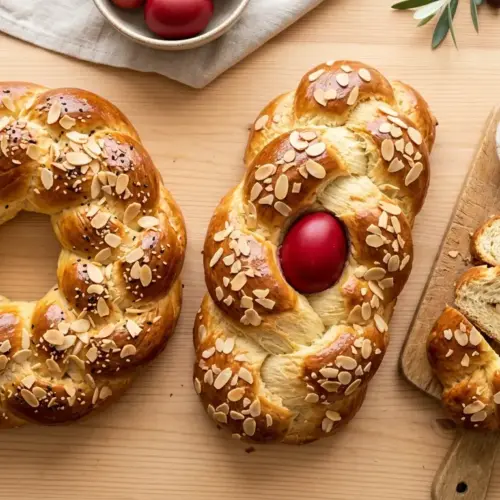
Greek Easter Bread (Tsoureki)

This Greek Easter Bread recipe, known as tsoureki, is a soft, pillowy sweet bread with a golden, glossy crust and a pull-apart interior that practically melts in your mouth. The combination of mahleb and mastic gives it a signature fragrance and a flavor that is deeply warming, faintly floral, and unlike anything you have tasted in an ordinary loaf.
Equipment
- Stand mixer with dough hook - highly recommended for proper gluten development
- Digital kitchen scale - for precise measurements
- Instant-read thermometer - to check water temperature and internal bread temperature
- Large mixing bowls
- Mortar and pestle or spice grinder - for grinding whole mahleb seeds and mastic
- Baking sheet lined with parchment paper
- Plastic wrap or a clean kitchen towel - for covering rising dough
- Pastry brush - for applying egg wash
- Wire cooling rack
- Heavy aluminum baking sheet - recommended for even heat distribution
Ingredients
- 5 cups bread flour - 625g, plus extra for dusting
- 2.25 teaspoons active dry yeast - 7g
- 0.5 cup warm water - 120ml, 100-110°F / 38-43°C
- 1 cup whole milk - 240ml, warm
- 0.5 cup granulated sugar - 100g, divided
- 0.5 cup unsalted butter - 115g, softened
- 3 large eggs - room temperature, 2 for dough, 1 for egg wash
- 1 tablespoon mahleb - 8g, finely ground
- 0.5 teaspoon mastic gum - finely ground, do not exceed this amount
- orange zest - from 1 large orange
- 1 teaspoon pure vanilla extract
- 0.25 teaspoon salt
- 1 tablespoon milk - for egg wash
Optional Toppings
- red-dyed hard-boiled eggs - for traditional garnish
- slivered almonds - for sprinkling on top
- sesame seeds - for sprinkling on top
Instructions
- Grind the spices: Freeze mastic crystals for 10-15 minutes, then grind with a pinch of sugar into a fine powder. Grind mahleb seeds separately until very fine. Measure 1/2 teaspoon mastic and 1 tablespoon mahleb.
- Bloom the yeast: Combine warm water with 1 teaspoon of sugar and active dry yeast. Let stand for 8-10 minutes until foamy and bubbly.
- Warm butter-milk mixture: In a saucepan over low heat, combine milk, butter, orange zest, vanilla, mahleb, and mastic. Heat until butter melts and mixture is warm (100°F/38°C). Do not boil.
- Mix the dough: In stand mixer bowl, combine remaining sugar, salt, 2 eggs, cooled butter-milk mixture, and yeast mixture. Add flour and mix with paddle until shaggy dough forms. Switch to dough hook.
- Knead the dough: Knead on medium-high for 15-20 minutes until smooth, elastic, and slightly tacky. Do not add extra flour. The dough should be soft and pull away from bowl walls.
- First rise: Transfer dough to a greased bowl, cover, and let rise in a warm place until doubled in size, about 2-4 hours.
- Divide and rest: Gently deflate dough and divide into 6 equal pieces for 2 loaves or 3 for 1 large loaf. Cover and let rest for 10 minutes.
- Shape and braid: Roll each piece into a 14-16 inch rope. Braid 3 strands together, pinching ends firmly. Tuck ends underneath. Repeat for second loaf. Press red-dyed egg into top if desired.
- Second rise: Cover loaves and let rise for 45 minutes to 1 hour until puffed. Gently press side; it should spring back slowly.
- Apply egg wash and bake: Preheat oven to 350°F (175°C). Brush loaves with egg wash (1 egg whisked with 1 tablespoon milk). Sprinkle with almonds or sesame seeds if desired. Bake 30-35 minutes until deep golden brown. Tent with foil if browning too quickly. Internal temperature should reach 190-195°F (88-90°C).
- Cool completely: Transfer to wire rack and cool for at least 45 minutes to 1 hour before slicing to prevent gummy texture.
Notes
- Room temperature ingredients: Pull butter, eggs, and milk out of the fridge at least 1 hour before baking. Cold ingredients slow down yeast activity.
- Don't skip kneading: The 15-20 minutes of kneading is essential for developing the gluten strands that create tsoureki's signature stringy, pull-apart texture.
- Measure mastic carefully: Even a small amount extra can make the bread noticeably bitter. Use the 1/2 teaspoon guideline exactly.
- Check your yeast: If you don't see foam after 10 minutes during the bloom stage, start over with a fresh packet. Dead yeast produces a flat, brick-like loaf.
- Resist adding extra flour: The dough is meant to be soft and slightly tacky. Adding too much flour results in a dry, tough loaf.
- Freeze mastic before grinding: Room-temperature mastic becomes gummy and sticks to everything. A quick freeze makes it brittle and easy to grind into powder.
- Storage: Wrap tightly in plastic wrap and store at room temperature for 4-5 days. For longer storage, freeze for up to 2 months.
- Make ahead: Shape and braid the loaves, then refrigerate overnight for a slow cold proof. Remove 1-2 hours before baking to come to room temperature.
- Orange syrup glaze: For extra moisture, brush warm baked loaves with a simple syrup made from equal parts sugar and water with juice of half an orange.
- Variations: Try chocolate tsoureki by rolling chocolate hazelnut spread into each rope before braiding, or make mini individual loaves for gifting.