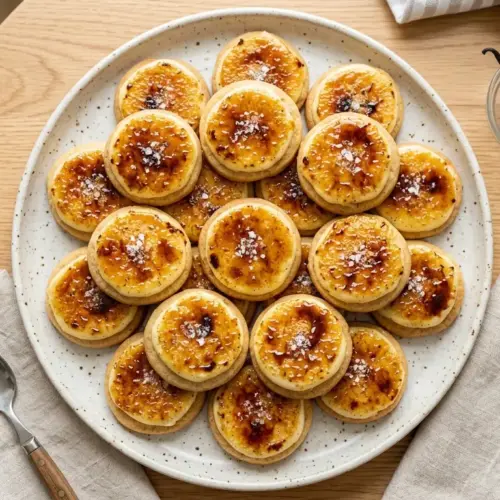
Creme Brulee Cookies

These cookies nail that signature creme brulee experience: a soft, buttery sugar cookie base topped with silky vanilla pastry cream, finished with a caramelized sugar shell you crack right through with a spoon. Every bite delivers that perfect contrast between the crisp brulee layer and the creamy custard underneath.
Equipment
- Two large baking sheets
- Parchment paper - or silicone baking mats
- Stand mixer - or hand mixer
- Medium saucepan
- Heatproof mixing bowls
- Fine-mesh strainer
- Piping bag - with a round tip or a zip-lock bag with the corner snipped
- Cookie scoop - about 2 tablespoons / 30 ml capacity
- Culinary torch - non-negotiable for this recipe
- Plastic wrap
- Wire cooling rack
- Offset spatula
- Measuring cups and spoons
Ingredients
For the Sugar Cookie Dough
- 2 1/4 cups all-purpose flour - 280g
- 1/2 tsp baking powder
- 1/4 tsp salt
- 1 cup unsalted butter - 225g, softened to room temperature
- 3/4 cup granulated white sugar - 150g
- 1 large egg - at room temperature
- 2 tsp vanilla bean paste
For the Vanilla Pastry Cream
- 2 cups whole milk - 480 ml
- 4 large egg yolks
- 1/2 cup granulated white sugar - 100g
- 1/4 cup cornstarch - 30g
- 1/4 tsp salt
- 2 tsp vanilla bean paste
- 2 tbsp unsalted butter - 28g, cold and cubed
For the Brulee Topping
- 1/2 cup granulated white sugar - 100g, for sprinkling and torching
Instructions
- Make the pastry cream first. Warm milk and vanilla bean paste in a saucepan over medium heat until steaming. Whisk egg yolks, sugar, cornstarch, and salt until pale and thick. Temper by slowly whisking in hot milk, then return to saucepan and cook while stirring constantly until bubbling and thickened. Remove from heat, stir in cold butter cubes until melted, then strain through a fine mesh sieve. Press plastic wrap directly on the surface and refrigerate for at least 2 hours.
- Preheat oven to 350°F (175°C) and line baking sheets with parchment. Whisk together flour, baking powder, and salt in a medium bowl. Beat softened butter and sugar in a stand mixer until light and fluffy. Add egg and vanilla bean paste, beating until smooth. Reduce mixer speed and add flour mixture, mixing just until combined.
- Portion dough into 2-tablespoon balls and place 2 inches apart on baking sheets. Press a shallow well into the center of each dough ball using the back of a measuring spoon. Bake for 11-13 minutes until edges are set and centers are slightly underdone. Reinforce the wells while warm, then cool completely on a wire rack.
- Once cookies and pastry cream are fully cooled and chilled, stir the pastry cream to loosen slightly. Transfer to a piping bag and pipe a generous mound into the well of each cookie, creating a slightly domed surface. Refrigerate filled cookies for 15-20 minutes to firm up before torching.
- Sprinkle a thin, even layer of granulated sugar over each pastry cream mound. Hold a culinary torch 2-3 inches above the sugar and move in slow circular motions until the sugar melts and turns a deep golden amber. Let rest for 1-2 minutes to set, then serve immediately for the best crunch.
Notes
- Chill the pastry cream thoroughly. Warm or under-chilled pastry cream will spread off the cookie and melt when torched. Give it a full 2 hours in the fridge, ideally overnight.
- Use vanilla bean paste, not extract. The paste provides a more concentrated vanilla flavor and contains real vanilla specks that make your pastry cream look authentic. It makes a noticeable difference in both taste and appearance.
- Do not overbake the cookies. They should look slightly underdone when you pull them from the oven. Overbaked cookies will be dry and crumbly, making it harder for them to hold the weight of the pastry cream.
- Work with cold pastry cream when torching. Cold pastry cream is less likely to melt away from the heat of the torch, especially with the double-layer sugar method.
- Keep the torch moving. A stationary flame will burn the sugar in one spot while leaving others uncaramelized. Steady, circular motions give you an even, glassy brulee shell.
- Torch right before serving. The crunch is best within the first 10 to 15 minutes after torching. If you need to prep ahead, fill the cookies and refrigerate, then torch just before serving.
- Sprinkle sugar evenly. Bare patches in the sugar layer will not caramelize, leaving you with a spotty topping. Use a small spoon to distribute the sugar as evenly as possible.
- Make-ahead friendly. The pastry cream can be prepared a day in advance and the cookies can be baked ahead, so you only need to torch and serve on the day.
- Without a torch? Use your oven's broiler as a substitute. Place filled cookies on a baking sheet under a hot broiler for 30-60 seconds, watching constantly. Results are less precise but work in a pinch.
- Storage: Store torched cookies in an airtight container in the refrigerator for up to 2 days. Re-sprinkle with sugar and torch again briefly before serving to restore the crunch. Plain baked cookies can be frozen for up to 2 months.