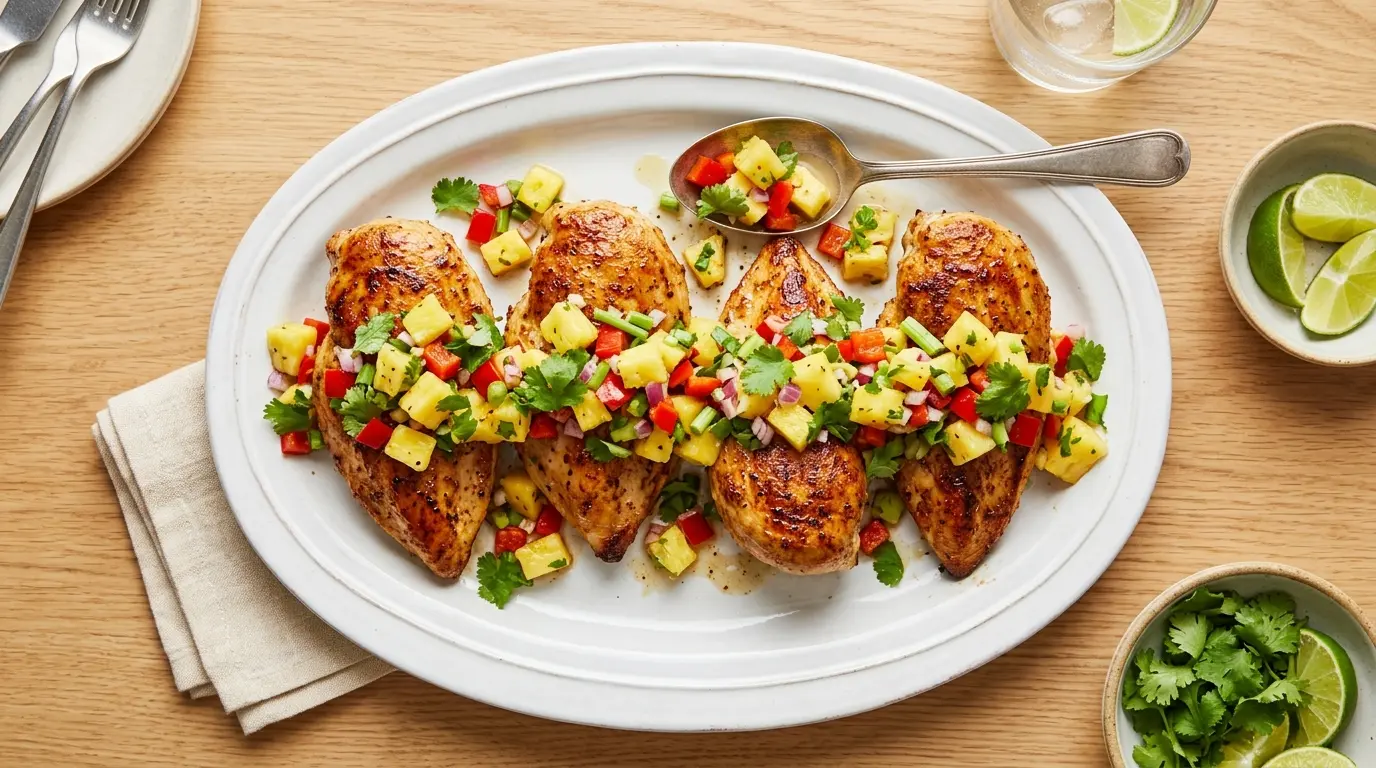
If you’re looking for a dinner that somehow manages to be both fresh and deeply satisfying, this pineapple salsa chicken recipe is exactly what you need on your table tonight.
Juicy, golden-seared chicken breasts get topped with a bright, chunky pineapple salsa that hits all the right notes: sweet, tangy, a little spicy, and packed with fresh herbs. It’s the kind of recipe that looks impressive but comes together in about 30 minutes.
The secret is in the seasoning. A simple blend of cumin, smoked paprika, garlic powder, and onion powder gives the chicken a warm, slightly smoky flavor that pairs perfectly with the cool, citrusy salsa on top.
This dish works for a relaxed weeknight dinner just as easily as it does for a summer backyard gathering. Serve it over cilantro lime rice and you have a full, vibrant meal that feels like something you’d order at a restaurant.

Why You’ll Love This Pineapple Salsa Chicken Recipe
This recipe has earned a permanent spot in weekly dinner rotations for good reason.
It checks every box: fast, flavorful, colorful, and genuinely crowd-pleasing without being complicated. Even picky eaters tend to love the sweet-and-savory combination that fresh pineapple brings.
The pineapple salsa doubles as both a topping and a sauce, meaning you don’t have to make a separate gravy or drizzle. Everything you need is right there in that vibrant spoonful.
It’s also naturally gluten-free and dairy-free, making it a great option for tables with dietary restrictions. You can prepare the salsa ahead of time, so when dinner time hits, you’re mostly just cooking chicken.
Here’s a quick look at why this recipe keeps coming up in dinner conversations:
- Ready in 30 minutes from start to finish, with zero complicated techniques
- Fresh, whole-food ingredients that are easy to find at any grocery store
- Naturally gluten-free and dairy-free without any special substitutions
- Versatile serving options: over rice, in tacos, in lettuce cups, or as a burrito bowl
- Kid-friendly thanks to the naturally sweet flavor of the pineapple
- Meal-prep friendly since the salsa keeps well in the fridge for up to three days
- Balanced nutrition with lean protein and vitamin-rich toppings in every serving
Read Also: Mango Salsa Chicken Recipe
Ingredients
The ingredient list for this recipe is refreshingly short. The salsa requires a few fresh items that are easy to prep, and the chicken seasoning uses pantry staples you likely already have on hand. Fresh pineapple will give you the best flavor and texture in the salsa, but canned pineapple (drained well) works in a pinch.
For the Chicken:
- 4 boneless, skinless chicken breasts (about 6–8 oz / 170–225g each)
- 1 tablespoon olive oil
- 1 teaspoon garlic powder
- 1 teaspoon onion powder
- 1 teaspoon ground cumin
- 1/2 teaspoon smoked paprika
- 1/2 teaspoon salt
- 1/4 teaspoon black pepper
For the Pineapple Salsa:
- 2 cups (330g) fresh pineapple, finely diced (about 1/2 a medium pineapple)
- 1/2 cup (75g) red bell pepper, finely diced
- 1/4 cup (40g) red onion, finely diced
- 1 jalapeño, seeds removed and finely minced (leave seeds in for extra heat)
- 1/4 cup (15g) fresh cilantro, roughly chopped
- 2 tablespoons fresh lime juice (about 1 large lime)
- 1/4 teaspoon salt
- 1/4 teaspoon black pepper
You might also enjoy this salsa verde chicken recipe for another bright and tangy twist on a classic.
Kitchen Equipment Needed
You don’t need any specialized tools for this recipe. A good heavy-bottomed skillet is the most important piece of equipment here because it allows the chicken to develop a proper golden sear rather than just steaming in its own juices.
- Cast iron skillet or heavy-bottomed stainless steel pan (12-inch recommended)
- Sharp chef’s knife for dicing the pineapple and vegetables
- Cutting board (one for the chicken, one for the produce if possible)
- Instant-read meat thermometer to check for doneness
- Mixing bowl for the salsa
- Measuring spoons and cups
- Tongs for flipping the chicken
- Citrus juicer or fork for squeezing the lime
- Meat mallet or rolling pin (optional, for pounding chicken to even thickness)
Read Also: Baked Salsa Chicken Recipe
Recommended Products for This Recipe
These are products I genuinely recommend based on how they perform in this specific recipe. Using quality tools and ingredients really does make a noticeable difference.
1. Lodge Pre-Seasoned Cast Iron Skillet
A cast iron skillet is the single best tool for getting a golden, restaurant-style sear on chicken. It holds heat evenly across the entire surface, which means your chicken cooks through without drying out at the edges. It goes from stovetop to oven if needed and only gets better with use over time.
2. ThermoPro Instant Read Meat Thermometer
Overcooked chicken is dry and disappointing, and undercooked chicken is unsafe. A reliable instant-read thermometer takes the guesswork out entirely. Simply check that the thickest part of the breast reads 165°F (74°C) and you’re done.
3. OXO Good Grips Citrus Juicer
Fresh lime juice in the salsa is non-negotiable for that bright, acidic punch that balances the sweetness of the pineapple. A handheld citrus juicer extracts far more juice than squeezing by hand, and it catches seeds automatically.
4. Misen Chef’s Knife
Finely dicing pineapple, jalapeño, and red onion is much easier with a sharp, well-balanced knife. A quality chef’s knife cuts cleanly rather than crushing the fruit, which keeps the salsa’s texture where you want it.
5. Fresh Pineapple (Pre-Cut, Refrigerated)
If you want to save prep time, many grocery stores carry pre-cut fresh pineapple in the refrigerated produce section. This is a great shortcut that doesn’t sacrifice the fresh flavor you’d miss with canned pineapple. Just make sure it’s labeled “fresh” and not packed in syrup.
This pairs wonderfully over a bowl of cilantro lime rice for a complete and colorful plate.

Step-by-Step Instructions
Step 1: Make the Pineapple Salsa
Start with the salsa first so the flavors have time to meld while you cook the chicken.
- Dice the fresh pineapple into small, uniform pieces no larger than 1/4 inch. The smaller the dice, the more the flavors combine in each bite rather than tasting separately.
- Finely dice the red bell pepper to a similar size as the pineapple.
- Finely dice the red onion. If you find raw onion too sharp, soak the diced onion in cold water for 5 minutes, then drain. This mellows the bite significantly.
- Remove the jalapeño seeds if you want mild heat, or leave them in for more spice. Mince the jalapeño as finely as possible.
- Roughly chop the fresh cilantro, including some of the stems, which carry excellent flavor.
- Add all salsa ingredients to a medium mixing bowl: pineapple, red bell pepper, red onion, jalapeño, and cilantro.
- Squeeze the lime over the bowl, catching any seeds with your hand or a small strainer. Add 2 tablespoons of fresh lime juice.
- Season with 1/4 teaspoon salt and 1/4 teaspoon black pepper.
- Stir everything together gently. Taste and adjust seasoning as needed, adding more lime or salt if desired.
- Set the salsa aside at room temperature while you cook the chicken. Room temperature salsa is preferable to cold straight from the fridge as a topping.
Step 2: Prepare the Chicken
Proper prep here makes a real difference in how evenly and quickly the chicken cooks.
- Remove the chicken breasts from the packaging and pat them completely dry with paper towels. This step is critical: moisture on the surface of the chicken will cause it to steam rather than sear, preventing that beautiful golden crust from forming.
- If the chicken breasts are thick (more than 1 inch / 2.5cm at the thickest point), place one breast at a time in a resealable zip-top bag or between two sheets of plastic wrap. Use a meat mallet, rolling pin, or the bottom of a heavy pan to gently pound the thicker end down to an even thickness. This ensures the chicken cooks through before the outside becomes dry.
- In a small bowl, combine the garlic powder, onion powder, ground cumin, smoked paprika, salt, and black pepper. Mix together until evenly combined.
- Drizzle the olive oil over both sides of all four chicken breasts.
- Sprinkle the spice mixture evenly over all sides of each chicken breast. Press the spices gently into the surface of the chicken with your fingertips so they adhere well during cooking.
Step 3: Sear the Chicken
- Heat a 12-inch cast iron or heavy-bottomed stainless steel skillet over medium-high heat. Allow the pan to heat for at least 2 minutes before adding anything to it. A properly preheated pan is essential for a good sear.
- Once the pan is hot, add the seasoned chicken breasts in a single layer. Do not crowd the pan. If your pan is smaller, cook the chicken in two batches. Crowding causes steaming instead of searing.
- Cook the chicken without moving it for 5 to 7 minutes on the first side. Resist the urge to peek or move the chicken during this time. The chicken will naturally release from the pan when it’s properly seared. If it sticks, it isn’t ready to flip yet.
- Using tongs, flip the chicken breasts over to the second side.
- Continue cooking for another 5 to 7 minutes, or until the internal temperature reaches 165°F (74°C) when measured with an instant-read thermometer inserted into the thickest part of the breast. Cooking time will vary based on the thickness of the breasts.
Step 4: Rest the Chicken
- Remove the chicken from the pan and transfer to a clean cutting board or plate.
- Loosely tent with a piece of aluminum foil and let the chicken rest for 5 minutes before slicing or serving. This resting period allows the juices to redistribute throughout the meat. Cutting too early causes those juices to run out onto the board, leaving the chicken drier than it should be.
Step 5: Slice and Serve
- After resting, slice the chicken diagonally into strips for an attractive presentation, or leave the breasts whole for a more casual plating.
- Spoon a generous portion of the pineapple salsa directly over the chicken.
- Serve immediately with your choice of sides such as cilantro lime rice, black beans, or warm tortillas.
You might also love this crockpot salsa chicken recipe for days when you want a hands-off, slow cooker version of a similar dish.
Tips for Success
A few small adjustments can take this recipe from good to genuinely excellent. These are the details that make a real difference in the final result.
- Pat the chicken completely dry before seasoning. Moisture is the enemy of a good sear, and this one step is responsible for most of the color and crust you get on the outside of the chicken.
- Let the pan get fully hot before adding the chicken. You should see a little wisp of smoke from the oil when the pan is ready. A cold pan produces steamed, pale chicken instead of the golden, flavorful crust you’re after.
- Don’t move the chicken while it sears. Set it down and leave it alone. The crust forms when the surface stays in contact with the hot pan. Moving it repeatedly breaks that crust before it has time to develop.
- Use fresh pineapple over canned for the salsa if possible. Fresh pineapple has a firmer texture and more complex flavor. Canned pineapple can work but it tends to be softer and sweeter, which can throw off the balance of the salsa.
- Dice everything finely and uniformly. The salsa benefits enormously from small, consistent pieces. When everything is roughly the same size, each bite has all the flavors in one go.
- Make the salsa at least 15 minutes ahead. Even a short rest allows the lime juice to soften the onion slightly and lets all the flavors begin to meld together. Overnight in the fridge is even better.
- Season aggressively. The chicken is a blank canvas. The spice rub should completely coat every surface. Don’t be shy with the seasoning.
Another great recipe to have in your back pocket is this instant pot salsa chicken recipe for ultra-fast weeknight cooking.
Serving Suggestions
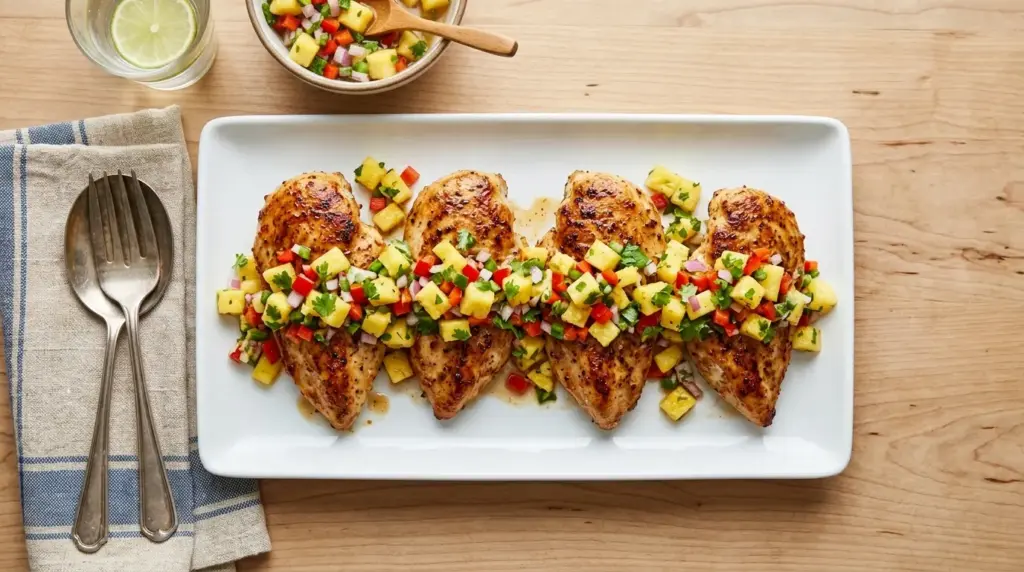
Pineapple salsa chicken is wonderfully versatile and adapts beautifully to however you want to serve it.
The dish pairs best with sides that are slightly neutral in flavor so they don’t compete with the bright, bold salsa. Think simple grains, mild beans, or cool, crunchy vegetables that offer a textural contrast to the juicy chicken.
Here are some of the best ways to serve it:
- Over Cilantro Lime Rice for the most classic and complementary pairing
- In warm flour or corn tortillas for easy Chicken Tacos with the salsa as the topping
- In lettuce cups for a light, low-carb option using butter or romaine lettuce leaves
- Over Mexican Rice for a heartier, more substantial plate
- With a side of Refried Beans and warm tortilla chips for a Tex-Mex style spread
- On top of a green salad with sliced avocado and a lime vinaigrette for a fresh summer bowl
- As a burrito bowl with rice, black beans, corn, and a dollop of sour cream
Variations to Try
Once you’ve made the base recipe, it’s easy to riff on it in all sorts of delicious directions. The core formula (spiced chicken plus fresh fruit salsa) is endlessly adaptable.
- Grilled version: Instead of pan-searing, grill the chicken over medium-high heat for 6 to 7 minutes per side. Grilling adds a smoky char that pairs beautifully with the sweet pineapple. You can even grill the pineapple itself before dicing it into the salsa for a deeper, caramelized sweetness.
- Baked version: Season the chicken and bake at 425°F (220°C) for 20 to 25 minutes or until 165°F (74°C) internally. This is the most hands-off option and great for cooking a larger batch.
- Spicy version: Add 1/4 teaspoon of cayenne pepper to the spice rub and leave the jalapeño seeds in the salsa for serious heat lovers.
- Mango pineapple salsa: Replace half the pineapple with finely diced fresh mango for a tropical twist that works exceptionally well in the summer months.
- Coconut-marinated chicken: Marinate the chicken in coconut milk, lime juice, and garlic for 30 minutes before cooking for a Caribbean-inspired flavor profile.
- Shrimp version: Swap the chicken for large peeled and deveined shrimp. Season and sear for 2 to 3 minutes per side. The pineapple salsa works just as brilliantly with shellfish.
- Air fryer version: Cook seasoned chicken breasts in the air fryer chicken breast recipe style at 375°F (190°C) for 18 to 22 minutes, flipping halfway through.
Storage and Reheating
This recipe stores well, making it an excellent option for meal prep. Keep the chicken and salsa in separate containers for the best results, as storing them together can make the chicken soggy.
- Refrigerator: Store the cooked chicken in an airtight container for up to 4 days. Store the pineapple salsa separately in an airtight container for up to 3 days.
- Freezer: The cooked chicken freezes well for up to 3 months. Wrap individual portions tightly in plastic wrap, then place in a zip-top freezer bag. The pineapple salsa does not freeze well as the texture of the fresh ingredients becomes mushy after thawing.
- Reheating chicken on the stovetop: Place chicken in a skillet over medium heat with a splash of chicken broth or water. Cover and heat for 3 to 4 minutes per side until warmed through. Adding a small amount of liquid prevents the chicken from drying out during reheating.
- Reheating in the microwave: Place chicken on a microwave-safe plate, cover with a damp paper towel (this traps steam and keeps the chicken moist), and heat in 60-second intervals until warmed through.
- Serving leftover chicken cold: Leftover chicken sliced over a salad with a scoop of fresh pineapple salsa is genuinely excellent the next day and requires zero reheating.
For another make-ahead chicken option you’ll love, check out this baked chicken breast recipe.
Nutritional Facts
The following estimates are based on one serving (one chicken breast with a generous portion of pineapple salsa). Exact values will vary depending on the size of the chicken breasts and the specific ingredients used.
- Calories: approximately 290 kcal
- Protein: 38g
- Carbohydrates: 16g
- Fat: 7g
- Saturated Fat: 1.5g
- Fiber: 2g
- Sugar: 12g (naturally occurring from pineapple)
- Sodium: 520mg
- Vitamin C: approximately 70% of daily recommended intake
- Vitamin A: approximately 20% of daily recommended intake
- Iron: approximately 8% of daily recommended intake
This is a genuinely nutritious meal with an excellent protein-to-calorie ratio. The majority of the carbohydrates and sugars come from the fresh pineapple and bell pepper in the salsa, not from added sugars.
You might also enjoy: Chipotle Chicken Recipe
Health Benefits of Key Ingredients
Every ingredient in this recipe brings something genuinely beneficial to the table, not just flavor.
This dish is a great example of food that is both delicious and nourishing. The combination of lean protein, anti-inflammatory spices, and vitamin-rich fresh produce makes it a well-rounded choice for a healthy lifestyle.
Here’s a closer look at what each key ingredient contributes:
- Chicken breast is one of the leanest sources of complete protein available, supporting muscle repair, satiety, and immune function. A single serving provides over 35 grams of protein with minimal fat.
- Fresh pineapple contains bromelain, a powerful enzyme that aids in protein digestion and has documented anti-inflammatory properties. It’s also an excellent source of Vitamin C and manganese.
- Red bell pepper is one of the richest sources of Vitamin C in the produce aisle, often containing more than an orange by weight. It also provides a good dose of Vitamin A and antioxidants.
- Jalapeño contains capsaicin, the compound responsible for its heat, which has been shown to boost metabolism and has anti-inflammatory effects.
- Cumin is rich in iron and has antioxidant properties. It has been used in traditional medicine for digestive support and is a staple in many of the world’s healthiest cuisines.
- Garlic powder carries many of the same benefits as fresh garlic, including compounds shown to support cardiovascular health and immune function.
- Lime juice adds Vitamin C and acts as a natural preservative for the salsa. The acidity also enhances the absorption of plant-based iron from the other ingredients.
- Cilantro is high in Vitamin K and has been studied for its potential role in supporting healthy digestion and reducing oxidative stress.
Read Also: Coconut Curry Chicken Recipe
Frequently Asked Questions
1. Can I use canned pineapple instead of fresh?
Yes, canned pineapple can be used in the salsa, but there are a few things to keep in mind.
Drain the canned pineapple very thoroughly before dicing, as excess liquid will make the salsa watery. Choose pineapple packed in juice rather than syrup, as the syrup version adds significantly more sugar and can make the salsa overly sweet.
2. How do I know when the chicken is fully cooked?
The most reliable method is always an instant-read thermometer. The chicken is safely cooked when the thickest part reads 165°F (74°C).
If you don’t have a thermometer, you can cut into the thickest part of the breast. The meat should be completely opaque with no pink remaining and the juices should run clear. However, a thermometer is strongly recommended as visual checks are less reliable.
3. Can I make the pineapple salsa ahead of time?
Absolutely, and it actually improves with a little time. Making the salsa up to 24 hours in advance allows the flavors to meld beautifully.
Store it covered in the refrigerator. Give it a stir and a taste before serving, as you may want to add a fresh squeeze of lime juice to brighten it back up after the overnight rest.
4. What can I substitute for cilantro if I don’t like it?
Fresh flat-leaf parsley is the most common substitute and works well here. It has a clean, mild herbaceous flavor that complements the pineapple and lime without the soapy taste that some people associate with cilantro.
Fresh mint is another option that leans into the tropical angle of the dish. Use it sparingly (about half the amount) as the flavor is more intense.
5. Can I use chicken thighs instead of chicken breasts?
Boneless, skinless chicken thighs work excellently in this recipe and are arguably even more forgiving than breasts when it comes to avoiding dryness.
They take slightly longer to cook, typically 7 to 8 minutes per side over medium-high heat, and should also reach an internal temperature of 165°F (74°C). The richer flavor of thighs pairs beautifully with the bright, acidic pineapple salsa.
For another delicious salsa-based chicken dish, try this salsa chicken recipe.

Pineapple Salsa Chicken

Equipment
- 12-inch cast iron skillet or heavy-bottomed stainless steel pan
- Sharp chef's knife
- Cutting board - Use one for chicken and one for produce if possible
- Instant-read meat thermometer
- Mixing bowl - For the salsa
- Measuring spoons and cups
- Tongs - For flipping the chicken
- Citrus Juicer or Fork - For squeezing the lime
- Meat mallet or rolling pin - Optional, for pounding chicken to even thickness
Ingredients
- 4 boneless, skinless chicken breasts - about 6–8 oz / 170–225g each
- 1 tablespoon olive oil
- 1 teaspoon garlic powder
- 1 teaspoon onion powder
- 1 teaspoon ground cumin
- 1/2 teaspoon smoked paprika
- 1/2 teaspoon salt
- 1/4 teaspoon black pepper
For the Pineapple Salsa
- 2 cups fresh pineapple - 330g, finely diced (about 1/2 a medium pineapple)
- 1/2 cup red bell pepper - 75g, finely diced
- 1/4 cup red onion - 40g, finely diced
- 1 jalapeño - seeds removed and finely minced (leave seeds in for extra heat)
- 1/4 cup fresh cilantro - 15g, roughly chopped
- 2 tablespoons fresh lime juice - about 1 large lime
- 1/4 teaspoon salt
- 1/4 teaspoon black pepper
Instructions
- Dice the pineapple, bell pepper, onion, and jalapeño into small, uniform pieces. Combine in a bowl with cilantro, lime juice, salt, and pepper. Stir well and set aside.
- Pat the chicken breasts completely dry with paper towels. If thick, pound to even thickness. Combine all spices in a small bowl. Drizzle chicken with oil and coat evenly with the spice rub.
- Heat a cast iron or heavy-bottomed skillet over medium-high heat for 2 minutes. Add the chicken in a single layer and cook without moving for 5 to 7 minutes per side, until golden and internal temperature reaches 165°F (74°C).
- Transfer chicken to a cutting board, tent with foil, and let rest for 5 minutes. Slice diagonally, top with pineapple salsa, and serve immediately with desired sides.
Notes
- Pat chicken dry: Moisture is the enemy of a good sear. Patting the chicken completely dry before seasoning is the single most important step for getting a golden crust.
- Hot pan, cold oil: Let the pan heat up fully before adding the chicken. You should see a wisp of smoke from the oil when it’s ready.
- Don’t crowd the pan: If your pan is small, cook the chicken in batches. Overcrowding causes steaming instead of searing.
- Use fresh pineapple: Fresh pineapple has better texture and a more complex flavor than canned. If using canned, drain thoroughly and choose juice-packed over syrup-packed.
- Make salsa ahead: The salsa can be made up to 24 hours in advance. Store in the fridge and add a fresh squeeze of lime before serving to brighten the flavors.
- Substitute cilantro: If you don’t like cilantro, use fresh flat-leaf parsley or fresh mint (use half the amount for mint).
- Chicken thighs: Boneless, skinless chicken thighs work excellently here and are more forgiving. Cook for 7 to 8 minutes per side to 165°F (74°C).
- Storage: Store chicken and salsa separately in airtight containers. Chicken keeps for 4 days in the fridge or 3 months in the freezer. Salsa keeps for 3 days in the fridge but does not freeze well.
Final Thoughts
This pineapple salsa chicken recipe is one of those weeknight gems that earns a permanent rotation in any household that tries it.
It’s quick enough for a busy Tuesday but flavorful and colorful enough to serve to guests on a Saturday night. The combination of smoky, warmly spiced chicken topped with cool, citrusy, sweet pineapple salsa is genuinely balanced in a way that makes every bite satisfying from start to finish.
If you’ve been stuck in a chicken dinner rut, this recipe is exactly the kind of refresh that reminds you how exciting simple cooking can be.
Give this pineapple salsa chicken recipe a try and let us know how it turned out in the comments below. We’d love to hear how you served it and any tweaks you made along the way. Feel free to share it with a friend who could use a new dinner idea this week!
Recommended:
- Mango Chutney Recipe
- Chicken Fajita Recipe
- Corn Salsa Recipe
- Black Bean Quesadilla Recipe
- Fish Tacos Recipe
- Taco Seasoning Recipe
- Pico de Gallo Recipe
- Chicken Tortilla Soup Recipe
- Easy Salsa Recipe
- Street Tacos Recipe