
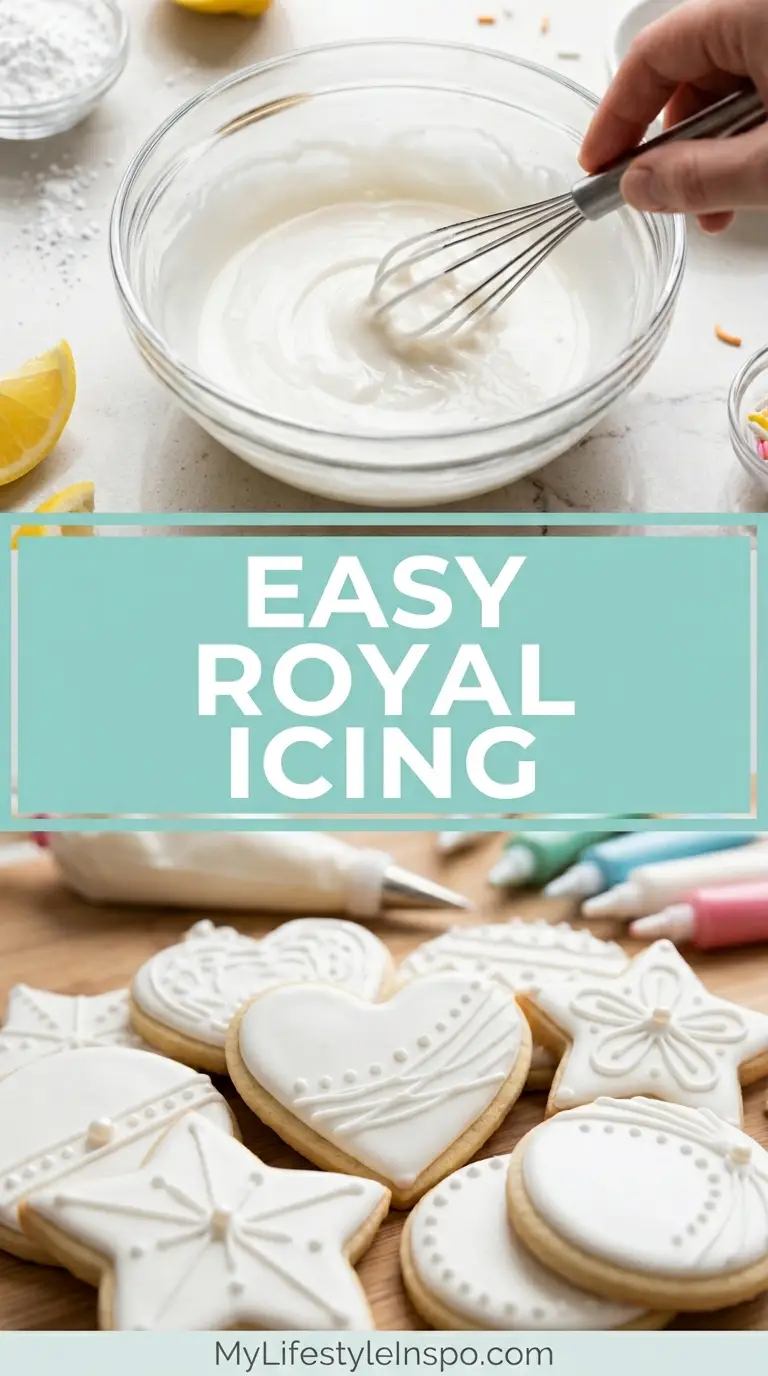
Creating beautifully decorated cookies starts with mastering one essential skill: making perfect royal icing. This easy royal icing recipe delivers professional-looking results with just a handful of simple ingredients.
The glossy, smooth finish that makes bakery cookies so stunning is completely achievable at home. Many bakers shy away from royal icing, thinking it requires special techniques or hard-to-find ingredients, but that couldn’t be further from the truth.
With this straightforward recipe, you’ll discover just how simple it is to create icing that dries beautifully, holds its shape perfectly for intricate designs, and tastes delicious. The best part is that you can adjust the consistency to suit any decorating need, from precise piping work to smooth flooding.
Gone are the days of struggling with icing that’s too thick to pipe or too runny to hold its shape. This recipe gives you complete control over the texture, making cookie decorating accessible even if you’re a complete beginner.
Making this easy royal icing recipe also eliminates the need for raw egg whites by using meringue powder, which is more stable and food-safe. It’s a game-changer for anyone who wants to decorate cookies without worrying about food safety concerns or inconsistent results.
For more delicious treats, try this classic sugar cookie recipe.
Why You’ll Love This Easy Royal Icing Recipe
This recipe stands out because it delivers bakery-quality results every single time, no matter your skill level. The consistency is easy to control, which means you can go from thick piping icing to smooth flooding consistency with just a few drops of water.
Unlike traditional royal icing recipes that use raw egg whites, this version uses meringue powder for safety and stability. You won’t have to worry about salmonella or inconsistent egg white quality affecting your final results.
The icing dries to a beautiful, smooth finish with a satisfying snap when you bite into your cookies, but it won’t chip your teeth like some overly hard royal icings. It also holds vibrant colors beautifully, so your decorated cookies will look as stunning as they taste.
Here’s what makes this recipe exceptional:
- Simple ingredients: Just three basic components that you can find at any grocery store or online
- Versatile consistency: Easily adjustable from thick piping to smooth flooding
- Food-safe: No raw eggs means safer decorating, especially when kids help
- Vibrant colors: Gel food coloring produces brilliant, fade-resistant hues
- Long shelf life: Stores well in the refrigerator for up to a week
- Professional finish: Dries hard enough to stack and package cookies without smudging
Ingredients
The beauty of this easy royal icing recipe lies in its simplicity. You only need three core ingredients to create professional-quality icing that decorates like a dream. Each ingredient plays a crucial role in achieving that perfect texture and finish.
For the Royal Icing:
- 3 cups (360g) confectioners’ sugar, sifted
- 3 tablespoons (21g) meringue powder
- 5-6 tablespoons (75-90ml) warm water
- 1 teaspoon vanilla extract or clear vanilla extract (optional, for flavor)
- Gel food coloring (optional, for decorating)
Notes on Ingredients:
- Confectioners’ sugar: Must be sifted to remove lumps for smooth, professional icing
- Meringue powder: The stabilizing agent that replaces egg whites and ensures food safety
- Water temperature: Warm water helps dissolve the meringue powder more effectively
- Extract choice: Clear vanilla keeps white icing pure white; regular vanilla adds slight color
You might also enjoy: Easy Sugar Cookie Recipe
Kitchen Equipment Needed
Having the right tools makes creating perfect royal icing much easier and ensures consistent results every time. Most of these items are standard kitchen equipment, but a few specialized tools will elevate your cookie decorating game.
- Stand mixer or hand mixer: For achieving stiff peaks and smooth consistency
- Fine-mesh sieve: Essential for sifting powdered sugar and removing lumps
- Large mixing bowl
- Rubber spatula for scraping down sides
- Measuring cups and spoons
- Small bowls for dividing and coloring icing
- Plastic wrap or damp towel (to prevent crusting)
- Piping bags (disposable or reusable)
- Piping tips (sizes 2, 3, or 4 work well)
- Squeeze bottles (optional, for flooding)
- Toothpicks or scribe tool (for smoothing and removing air bubbles)
Recommended Products for This Recipe
These carefully selected products will help you achieve professional results and make the cookie decorating process more enjoyable. I’ve tested dozens of brands and tools over the years, and these consistently deliver the best performance.
1. Wilton Meringue Powder
This is the gold standard for royal icing. It dissolves quickly, creates stable peaks, and gives icing that perfect glossy finish. Unlike cheaper brands, it doesn’t leave a chalky aftertaste.
2. AmeriColor Soft Gel Paste Food Coloring
These professional-grade gel colors produce vibrant, true-to-shade results without thinning your icing. A little goes a long way, and they won’t bleed or fade like liquid food coloring.
3. Ateco Decorating Tips Set
This comprehensive set includes all the tips you’ll need for outlining, flooding, and detailed work. The stainless steel construction ensures they maintain their shape even with repeated use.
4. Wilton Disposable Decorating Bags
These sturdy bags don’t burst under pressure and are the perfect size for cookie decorating. The convenience of disposable bags means less cleanup and no risk of oil contamination from washing.
5. Plastic Squeeze Bottles for Flooding
These bottles make flooding large areas quick and easy, with precise control over icing flow. The narrow tips prevent over-flooding and help you work cleanly around outlined edges.
This pairs wonderfully with classic chocolate chip cookies when you want variety in your cookie selection.
Step-by-Step Instructions
1. Sift the Confectioners’ Sugar
- Measure out 3 cups of confectioners’ sugar
- Place a fine-mesh sieve over your mixing bowl
- Sift the sugar through the sieve, using your fingers or a spoon to break up any lumps that won’t pass through
- This step is crucial because lumps will create bumps and imperfections in your finished icing
- Even if your sugar looks lump-free, sifting ensures the smoothest possible texture
2. Combine Dry Ingredients
- Add the 3 tablespoons of meringue powder to the sifted confectioners’ sugar in the mixing bowl
- Use a whisk or spatula to gently mix the meringue powder and sugar together until evenly distributed
- This preliminary mixing ensures the meringue powder won’t clump when you add the liquid
- Make sure to scrape the bottom and sides of the bowl so nothing settles
3. Add Liquid Ingredients
- Start your mixer on the lowest speed to prevent a sugar cloud
- Slowly pour in 5 tablespoons of warm water while the mixer runs
- Add the vanilla extract if using
- Keep the mixer on low speed until all the liquid is incorporated and the mixture looks moistened throughout
- The warm water helps the meringue powder dissolve more quickly and completely
4. Beat to Stiff Peaks
- Once everything is combined, increase the mixer speed to medium-high
- Beat for 5-7 minutes, stopping occasionally to scrape down the sides of the bowl with a rubber spatula
- Watch for the icing to transform from a loose mixture to thick, glossy icing that holds stiff peaks
- You’ll know it’s ready when you lift the beaters and the icing forms peaks that stand straight up without drooping
- The icing should be bright white and have a smooth, satiny appearance
5. Adjust Consistency
- Test the consistency by lifting some icing with a spoon or spatula
- For piping consistency (outlining cookies): The icing should hold a stiff peak and not flow at all. This is what you have right now.
- For flood consistency (filling in outlined areas): Add water 1/2 teaspoon at a time, mixing well after each addition. The icing should flow smoothly but settle flat within 10-15 seconds.
- For medium consistency (writing, details): Add small amounts of water until the icing holds a soft peak that slowly settles
- Always add water gradually because you can always thin icing, but thickening it requires more powdered sugar
6. Divide and Color
- Transfer the amount of icing you want to keep white into a separate bowl
- Divide remaining icing among small bowls, one for each color you plan to use
- Add gel food coloring to each bowl using a toothpick (gel color is very concentrated)
- Stir thoroughly until the color is evenly distributed with no streaks
- Cover each bowl immediately with plastic wrap pressed directly onto the surface to prevent crusting
- Remember that colors darken slightly as the icing dries
7. Fill Piping Bags or Bottles
- Place your piping tip inside a piping bag or fit a coupler if you plan to change tips
- Fold the top of the bag down to create a cuff, which keeps the outside of the bag clean
- Use a spatula to transfer icing into the bag, filling it about halfway full
- Twist the top of the bag to push the icing down and remove air pockets
- For squeeze bottles, simply spoon or pour the flood-consistency icing directly into the bottles
- Keep all filled bags and bottles covered with a damp cloth when not in use
8. Test and Decorate
- Before decorating your actual cookies, test the consistency on a piece of parchment paper
- Practice piping lines, dots, and filling shapes to get comfortable with the icing flow
- Adjust consistency with tiny amounts of water or powdered sugar as needed
- Begin decorating by outlining your cookies first with piping-consistency icing
- Let outlines set for 5-10 minutes before flooding the center with thinner icing
- Use a toothpick to guide icing into corners and pop any air bubbles
Read Also: Classic Deviled Eggs Recipe
Tips for Success
Mastering royal icing takes practice, but these expert tips will help you avoid common pitfalls and achieve professional results faster. Pay special attention to humidity levels and icing coverage, as these factors significantly impact your final results.
- Keep it covered: Royal icing forms a crust within minutes. Always keep bowls covered with plastic wrap pressed directly on the surface, and keep piping bag tips covered with a damp paper towel.
- Avoid grease: Even a tiny amount of oil or butter will prevent royal icing from setting properly. Wash all equipment with hot, soapy water and dry thoroughly.
- Test consistency: The “10-second test” is your friend. Drop icing from a spoon back into the bowl. If the surface smooths out in 10 seconds, it’s perfect flood consistency.
- Use gel colors: Liquid food coloring adds too much moisture and can prevent proper drying. Gel or paste colors are concentrated and won’t thin your icing.
- Be patient with drying: Decorated cookies need 6-8 hours to fully dry, sometimes up to 24 hours in humid conditions. Don’t stack or package them too soon.
- Control humidity: If possible, decorate in a room with low humidity. Use a dehumidifier or fans to help cookies dry faster.
- Add water gradually: It’s easy to overthin icing. Add water just a few drops at a time and mix well between additions.
- Sift thoroughly: Lumps in your sugar will create bumps in your finished icing. Take time to sift properly even if it seems tedious.
- Use warm water: Cold water doesn’t dissolve meringue powder as effectively. Warm (not hot) water creates smoother icing.
- Stir, don’t shake: When thinning icing, stir gently to avoid creating air bubbles. If bubbles form, let the icing rest for a few minutes and they’ll rise to the surface.
For an elegant appetizer, consider serving classic bruschetta.
Serving Suggestions

While royal icing is primarily used for decorating cookies, it’s incredibly versatile and can enhance many sweet treats. The hard, candy-like finish makes it perfect for any baked goods that benefit from decorative, stable icing.
Perfect pairings and uses:
- Sugar cookies: The classic pairing, especially cut-out sugar cookies for holidays
- Gingerbread: Use royal icing to assemble and decorate gingerbread houses or gingerbread people
- Shortbread: The buttery flavor of shortbread complements the sweet icing beautifully
- Graham crackers: Create edible houses, snowflakes, or decorated treats for kids
- Biscotti: Drizzle royal icing over biscotti for an elegant presentation
- Cake decorating: Pipe intricate details, flowers, or borders on celebration cakes
- Cupcakes: Create detailed toppers that can be made ahead and stored
- Macaron shells: Fill gaps between shells or pipe decorative designs
- Edible place cards: Write names on cookies for parties or special dinners
- Cookie pops: Decorate cookies on sticks for birthday parties or gifts
Read Also: Easy Tiramisu Recipe
Variations to Try
Royal icing is wonderfully adaptable to different flavors, colors, and decorating techniques. These variations will expand your repertoire and keep your cookie decorating fresh and exciting.
- Lemon royal icing: Replace vanilla extract with lemon extract for a bright, citrusy flavor that pairs beautifully with sugar cookies
- Almond royal icing: Use almond extract instead of vanilla for a sophisticated, nutty flavor perfect for wedding cookies
- Chocolate royal icing: Add 2-3 tablespoons of sifted cocoa powder to the recipe for rich chocolate icing (note: drying time may be longer)
- Tinted white icing: Add a tiny bit of white gel color to your white icing to prevent yellowing from the vanilla extract
- Metallic icing: Mix in edible luster dust or paint dried icing with gold or silver dust mixed with clear alcohol
- Ombré effect: Create gradual color transitions by making several batches of the same color in varying intensities
- Marbled icing: Drop different colored flood icing onto a wet base and swirl with a toothpick for a marbled effect
- Watercolor technique: Paint on dried royal icing with diluted gel colors for a soft, artistic look
- Transfer method: Pipe designs on parchment paper, let dry completely, then attach to cookies with a dab of fresh icing
- Stenciling: Use food-safe stencils and thinned royal icing to create intricate patterns and designs
If you love desserts with fruit, you’ll enjoy this classic apple pie.
Storage and Reheating
Proper storage ensures your royal icing stays fresh and usable for future decorating sessions. These guidelines will help you maximize the shelf life of both your prepared icing and decorated cookies.
For undecorated icing:
- Transfer icing to an airtight container immediately after making
- Press plastic wrap directly onto the surface of the icing to prevent crusting
- Store in the refrigerator for up to 1 week
- Bring to room temperature before using and re-whip with a mixer to restore consistency
- Add small amounts of water if icing has thickened in storage
- Check for any discoloration or off odors before using stored icing
For decorated cookies:
- Let cookies dry completely at room temperature for 6-8 hours minimum, up to 24 hours
- Once fully dry, store in airtight containers at room temperature for up to 2 weeks
- Layer cookies between sheets of parchment paper to prevent sticking
- Don’t refrigerate decorated cookies as moisture will make the icing weep
- Freeze decorated cookies for up to 2 months by wrapping individually in plastic wrap, then placing in freezer bags
- Thaw frozen cookies at room temperature, still wrapped, to prevent condensation
Another favorite: Creamy Mac and Cheese Recipe
Nutritional Facts
Per 2 tablespoon serving (based on 12 servings):
- Calories: 85
- Total Fat: 0g
- Saturated Fat: 0g
- Trans Fat: 0g
- Cholesterol: 0mg
- Sodium: 5mg
- Total Carbohydrates: 22g
- Dietary Fiber: 0g
- Sugars: 21g
- Protein: 0g
- Vitamin D: 0mcg
- Calcium: 2mg
- Iron: 0mg
- Potassium: 1mg
Percent Daily Values are based on a 2,000 calorie diet.
Note: Nutritional information is approximate and will vary based on specific ingredients and portion sizes. Royal icing is primarily used as a decorative element rather than a substantial food component, so servings are typically small.
Health Benefits of Key Ingredients
While royal icing is primarily a sweet treat, understanding the components can help you make informed decisions about your baking. Royal icing is essentially a decorative element rather than a nutritious food, but here’s what you should know about its ingredients.
Meringue powder provides protein without raw egg risks. Made from pasteurized egg whites, it eliminates concerns about salmonella while still delivering the protein and structure needed for stable icing. This makes it safer for pregnant women, young children, and anyone with compromised immune systems to enjoy decorated cookies.
Confectioners’ sugar provides quick energy. While high in simple carbohydrates, the sugar in royal icing provides immediate energy. Since royal icing is used in small amounts purely for decoration, the actual sugar consumed per cookie is minimal compared to the cookie itself.
Royal icing is naturally fat-free and low in sodium. Unlike buttercream or cream cheese frosting, royal icing contains no fats or oils, making it a lighter option from a caloric perspective. It also contains virtually no sodium, which may be beneficial for those monitoring salt intake.
Key nutritional considerations:
- Portion control: Royal icing is meant for decoration, not consumption in large quantities
- Allergen-friendly: Contains no dairy, nuts, or gluten (when made with pure ingredients)
- Egg protein: Provides small amounts of complete protein from the meringue powder
- No artificial ingredients: Made from simple, recognizable ingredients
- Food coloring: Choose natural gel colors if avoiding artificial dyes
Try this alongside classic chicken salad for a well-rounded meal.
Frequently Asked Questions
1. Can I use this easy royal icing recipe without meringue powder?
Yes, you can substitute fresh pasteurized egg whites for meringue powder. Use 3 tablespoons of pasteurized egg whites instead of the meringue powder and water combination. Beat the egg whites until frothy, then gradually add the confectioners’ sugar and vanilla, beating until stiff peaks form. The consistency and drying time will be similar, but always use pasteurized eggs for food safety when the icing won’t be cooked.
2. Why isn’t my royal icing drying properly?
Several factors can prevent royal icing from drying correctly. The most common culprit is grease or oil contamination from equipment, even a tiny amount of butter on a bowl. High humidity also significantly slows drying time, sometimes preventing icing from setting completely. Using too much water in your consistency or adding liquid food coloring instead of gel can also cause drying issues. Lastly, if egg yolk accidentally mixed into your egg whites (for non-meringue powder versions), the fat content will prevent proper setting.
3. How do I get my royal icing perfectly smooth without air bubbles?
Mix your icing on low to medium speed rather than high to minimize air incorporation. After mixing, let the icing rest for a few minutes so bubbles can rise to the surface, then gently stir with a spatula. When flooding cookies, use a toothpick or scribe tool to pop any visible bubbles and guide the icing into corners. Tapping the cookie gently on the counter can also help bubbles rise and pop. If you’re using a squeeze bottle, squeeze icing onto parchment first to release trapped air before decorating.
4. Can I make royal icing ahead of time and how long does it last?
Absolutely! Royal icing stores beautifully in the refrigerator for up to one week. Transfer it to an airtight container and press plastic wrap directly onto the surface to prevent crusting. When ready to use, bring it to room temperature and re-whip it with a mixer to restore the proper consistency. You may need to add a few drops of water if it has thickened. For longer storage, you can freeze royal icing for up to 3 months, though the texture may need extra mixing after thawing.
5. What’s the difference between piping and flooding consistency?
Piping consistency is thick and holds stiff peaks, similar to toothpaste. It’s used for outlining cookies, creating borders, and piping fine details that need to hold their shape. When you lift your spatula, the icing should stand up without drooping. Flooding consistency is much thinner and flows easily, similar to honey. It should be pourable but not runny, and when dropped from a spoon back into the bowl, the surface should smooth out completely in 10-15 seconds. This consistency fills in outlined areas and creates a smooth, flat surface.
This recipe complements easy lasagna beautifully for dinner parties.

Easy Royal Icing

Equipment
- Stand mixer or hand mixer
- Fine-mesh sieve - Essential for sifting powdered sugar
- Large mixing bowl
- Rubber spatula - For scraping down sides
- Measuring cups and spoons
- Small bowls - For dividing and coloring icing
- Plastic wrap or damp towel - To prevent crusting
- Piping bags - Disposable or reusable
- Piping tips - Sizes 2, 3, or 4 work well
- Squeeze bottles - Optional, for flooding
- Toothpicks or scribe tool - For smoothing and removing air bubbles (optional)
Ingredients
- 3 cups confectioners’ sugar - 360g, sifted
- 3 tablespoons meringue powder - 21g
- 5 tablespoons warm water - 75ml, plus additional 1-2 tablespoons (15-30ml) for thinning
- 1 teaspoon vanilla extract - or clear vanilla extract, optional for flavor
- gel food coloring - optional, for decorating
Instructions
- Place a fine-mesh sieve over your mixing bowl and sift the confectioners’ sugar to remove any lumps.
- Add the meringue powder to the sifted sugar and whisk together until evenly distributed.
- Start your mixer on low speed, then slowly pour in 5 tablespoons of warm water and the vanilla extract if using.
- Once combined, increase speed to medium-high and beat for 5-7 minutes until the icing forms stiff peaks that stand straight up without drooping.
- Test the consistency and adjust as needed. Add water 1/2 teaspoon at a time for flood consistency, or leave as-is for piping consistency.
- Divide the icing among small bowls and add gel food coloring using a toothpick, stirring thoroughly until evenly colored.
- Transfer icing to piping bags or squeeze bottles, keeping all filled bags covered with a damp cloth when not in use.
- Test the consistency on parchment paper, then decorate by outlining cookies first with piping-consistency icing, letting outlines set for 5-10 minutes before flooding.
Notes
- Keep it covered: Royal icing forms a crust within minutes. Always keep bowls covered with plastic wrap pressed directly on the surface, and keep piping bag tips covered with a damp paper towel.
- Avoid grease: Even a tiny amount of oil or butter will prevent royal icing from setting properly. Wash all equipment with hot, soapy water and dry thoroughly.
- Test consistency: The “10-second test” is your friend. Drop icing from a spoon back into the bowl. If the surface smooths out in 10 seconds, it’s perfect flood consistency.
- Use gel colors: Liquid food coloring adds too much moisture and can prevent proper drying. Gel or paste colors are concentrated and won’t thin your icing.
- Be patient with drying: Decorated cookies need 6-8 hours to fully dry, sometimes up to 24 hours in humid conditions. Don’t stack or package them too soon.
- Control humidity: If possible, decorate in a room with low humidity. Use a dehumidifier or fans to help cookies dry faster.
- Add water gradually: It’s easy to overthin icing. Add water just a few drops at a time and mix well between additions.
- Storage: Store undecorated icing in an airtight container in the refrigerator for up to 1 week. Bring to room temperature and re-whip before using.
- Freezing: Freeze decorated cookies for up to 2 months by wrapping individually in plastic wrap, then placing in freezer bags. Thaw at room temperature, still wrapped, to prevent condensation.
- Egg white substitute: To replace meringue powder, use 3 tablespoons of pasteurized egg whites instead of the meringue powder and water combination.
Final Thoughts
Royal icing transforms ordinary cookies into stunning works of art that look like they came straight from a professional bakery. This easy royal icing recipe takes the intimidation out of cookie decorating and empowers you to create beautiful designs with confidence.
The best part about mastering royal icing is watching your skills grow with each batch of cookies you decorate. What starts as simple dots and lines quickly evolves into intricate patterns, detailed images, and personalized creations that make every celebration special.
Don’t be discouraged if your first attempts aren’t perfect. Even professional bakers spend years refining their technique, and every decorated cookie teaches you something new about consistency, timing, and control.
Give this easy royal icing recipe a try for your next batch of cookies and see the difference that homemade icing makes. I’d love to hear about your decorating adventures and see photos of your beautiful creations in the comments below!
Recommended:
- Classic Tiramisu Recipe
- Belgian Waffle Recipe
- Old Fashioned Pancake Recipe
- Easy French Toast Recipe
- Best Carrot Cake Recipe
- Classic Shepherds Pie Recipe
- Baked Mac and Cheese Recipe
- Classic Chicken Parmesan Recipe
- Easy Pizza Dough Recipe
- Chewy Chocolate Chip Cookies Recipe