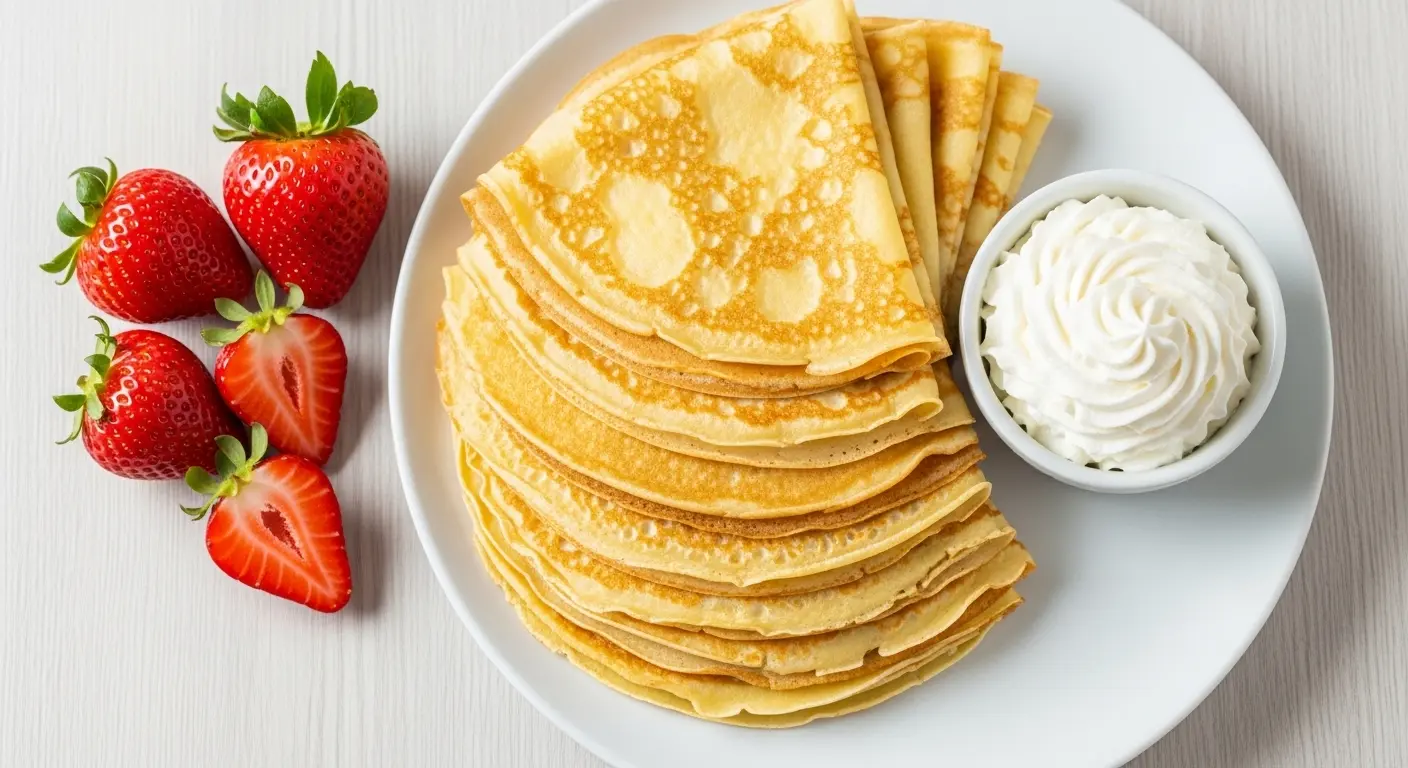
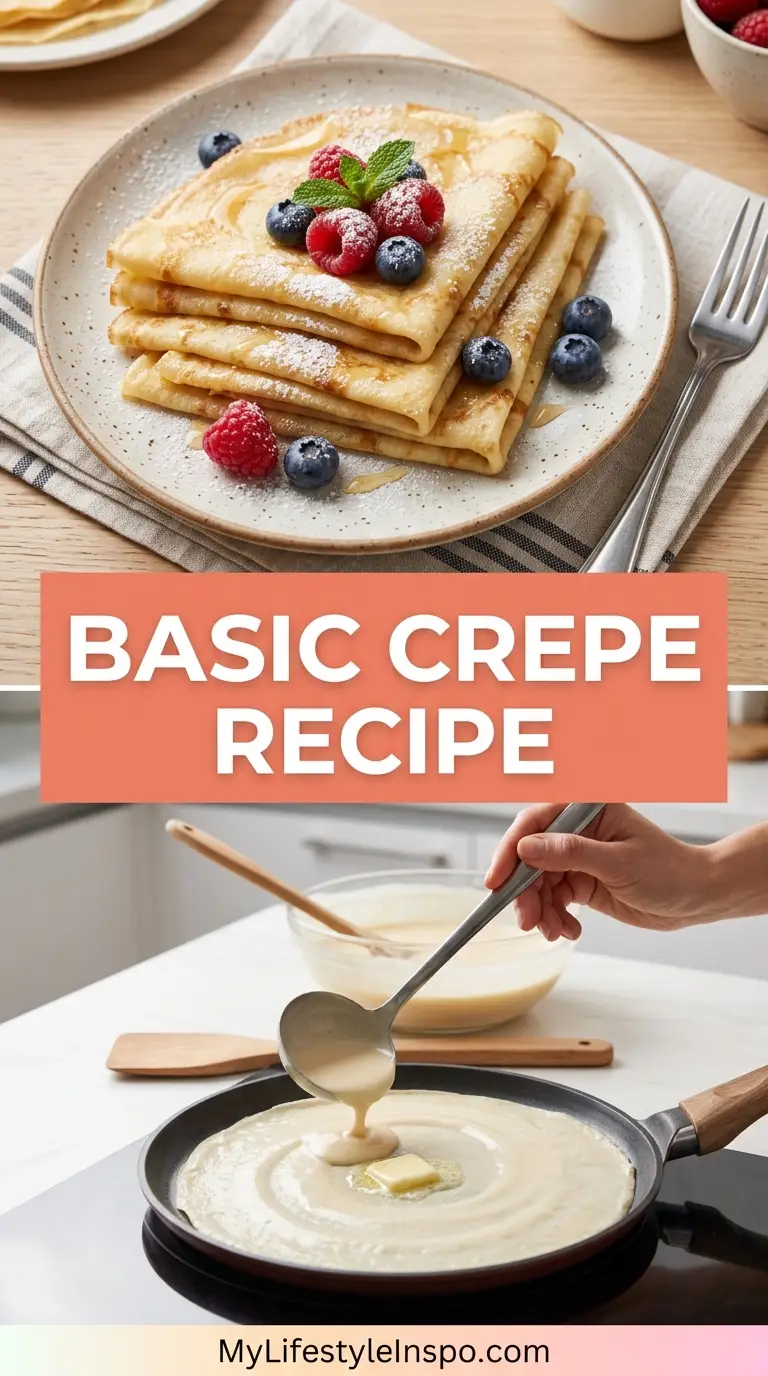
Thin, delicate, and endlessly versatile, a basic crepe recipe is one of those kitchen skills that transforms your cooking repertoire overnight. These French-style pancakes are deceptively simple to make, requiring just a handful of pantry staples and a good nonstick skillet.
The beauty of mastering a basic crepe recipe lies in its adaptability. You can fill these paper-thin pancakes with sweet ingredients like fresh berries and whipped cream, or go savory with ham, cheese, and sautéed mushrooms. The batter comes together in minutes, and once you nail the swirling technique, you’ll be cranking out golden, lacy crepes like a pro.
What makes this recipe truly special is how forgiving it is. Yes, your first crepe might look a little wonky, but that’s completely normal. By the second or third one, you’ll find your rhythm, and before you know it, you’ll have a beautiful stack ready for whatever filling your heart desires.
The key to perfect crepes is achieving the right consistency in your batter. Too thick and your crepes will be doughy; too thin and they’ll tear. This recipe strikes that perfect balance, giving you crepes that are sturdy enough to roll yet tender enough to melt in your mouth.
For breakfast paired with classic French toast, these crepes elevate any morning spread into something truly special.
Why You’ll Love This Basic Crepe Recipe
This basic crepe recipe delivers restaurant-quality results with minimal effort and equipment. You don’t need a fancy crepe maker or special ingredients, just a standard nonstick skillet and about seven basic items you probably already have in your kitchen.
The recipe is incredibly efficient. From start to finish, including resting time, you’ll have crepes ready in just over an hour. The actual hands-on time is even shorter, making this an ideal recipe for busy mornings or when you’re hosting brunch.
Here’s what makes this recipe stand out:
- Simple ingredients: No specialty flours or hard-to-find items required
- Versatile: Works equally well for sweet or savory preparations
- Make-ahead friendly: The batter can sit in the fridge for up to 24 hours, and cooked crepes freeze beautifully
- Budget-friendly: Uses inexpensive pantry staples to create an impressive dish
- Quick cooking: Each crepe takes less than a minute per side to cook
- Freezer-friendly: Make a double batch and freeze half for easy weekday breakfasts
- Kid-approved: Children love helping with the swirling technique and choosing their own fillings
- Crowd-pleaser: Serve a stack with various toppings and let guests customize their own
Another favorite breakfast option that shares the same ease is easy waffle recipe.
Ingredients
The ingredient list for this basic crepe recipe is refreshingly short and likely already waiting in your kitchen. Each component plays a crucial role in creating that signature thin, tender texture that makes crepes so irresistible.
- 2 cups (250g) all-purpose flour: Provides structure without making the crepes tough
- 4 large eggs: Binds the batter and adds richness
- 2 cups (480ml) whole milk: Creates the right consistency and adds creaminess
- 1/2 cup (120ml) water: Thins the batter for ultra-delicate crepes
- 4 tablespoons (56g) unsalted butter, melted and cooled: Adds flavor and prevents sticking
- 2 tablespoons granulated sugar: Provides subtle sweetness and helps with browning
- 1/4 teaspoon salt: Balances the flavors
- 1 teaspoon vanilla extract (optional for sweet crepes): Adds depth of flavor
You might also enjoy: Belgian Waffle Recipe
Kitchen Equipment Needed
You’ll need very little specialized equipment to make perfect crepes. The right tools make the process smoother, but nothing here is expensive or hard to find.
- Blender or whisk: For creating a smooth, lump-free batter
- 8-inch nonstick skillet or crepe pan: Essential for easy flipping and release
- Measuring cups and spoons: For accurate measurements
- Small ladle or 1/4 cup measuring cup: For portioning the batter
- Rubber spatula: For loosening the edges and flipping
- Large mixing bowl: If not using a blender
- Wire cooling rack: For stacking finished crepes
- Pastry brush or paper towel: For greasing the pan between crepes
- Small bowl for melted butter: Keeps butter accessible for brushing the pan
Read Also: Air Fryer French Toast Recipe
Recommended Products for This Recipe
These carefully selected products will elevate your crepe-making experience and ensure consistent, professional results every time you cook.
1. Le Creuset Enameled Cast Iron Crepe Pan
This 10.75-inch crepe pan distributes heat evenly across its wide, flat surface, making it simple to achieve those perfectly thin, golden crepes. The low sides make flipping easier, and the premium nonstick coating ensures every crepe releases cleanly. It’s an investment that will serve you for decades.
2. Vitamix Professional Series 750 Blender
This high-powered blender creates the smoothest crepe batter in seconds, eliminating any lumps that can ruin the texture of your crepes. The variable speed control lets you start slow to combine ingredients, then increase to achieve that silky consistency. It’s also perfect for making smoothies, soups, and other recipes.
3. OXO Good Grips Silicone Pastry Brush
This silicone brush makes greasing your pan between crepes effortless and mess-free. Unlike traditional brushes, the silicone bristles won’t shed or melt, and they’re dishwasher safe for easy cleanup. The angled head reaches into corners and spreads butter evenly.
4. Nielsen-Massey Madagascar Bourbon Pure Vanilla Extract
For sweet crepes, premium vanilla makes a noticeable difference. This Madagascar bourbon vanilla adds complex, rich flavor that elevates your crepes from good to exceptional. A little goes a long way, and the depth it provides is worth every penny.
For a lighter option, try: Buttermilk Pancake Recipe
Step-by-Step Instructions
Follow these detailed instructions to create perfectly thin, golden crepes every single time. Take your time with the first few, and you’ll quickly develop a rhythm.
1. Prepare the Batter
- Place the all-purpose flour in your blender, followed by the eggs, whole milk, water, granulated sugar, and salt
- Melt the unsalted butter in a microwave-safe bowl for 30-40 seconds, then let it cool for 5 minutes so it doesn’t scramble the eggs
- Add the cooled melted butter and vanilla extract (if using) to the blender
- Blend on medium speed for 15-20 seconds until the batter is completely smooth and free of lumps
- Scrape down the sides of the blender with a spatula to ensure all flour is incorporated
- If mixing by hand, whisk the eggs in a large bowl first, then gradually add the flour while whisking continuously to prevent lumps
- Slowly pour in the milk and water while whisking until smooth, then stir in the melted butter, sugar, salt, and vanilla
2. Rest the Batter
- Cover the blender or bowl with plastic wrap or a lid
- Refrigerate the batter for at least 30 minutes, or up to 24 hours for best results
- This resting period allows the flour to fully hydrate, creating a smoother texture
- It also lets any air bubbles from blending settle, preventing holes in your crepes
- If the batter seems too thick after resting, thin it with 1-2 tablespoons of water or milk
- The consistency should be similar to heavy cream, thin enough to coat the back of a spoon
3. Heat the Pan
- Place your 8-inch nonstick skillet or crepe pan over medium-low heat
- Let it preheat for about 2 minutes until evenly heated throughout
- Test the temperature by adding a small drop of water; it should sizzle gently without immediately evaporating
- If the pan is too hot, your crepes will cook too quickly and develop crispy edges instead of tender ones
- Have your melted butter and pastry brush ready beside the stove
- Keep the heat consistent throughout cooking; you may need to adjust between crepes
4. Grease the Pan
- Lightly brush the pan with melted butter using a pastry brush or folded paper towel
- You want just a thin coating, not pools of butter
- Too much butter will make the crepe greasy; too little will cause sticking
- The first crepe usually absorbs most of the initial butter, so don’t worry if it looks a bit greasy
- For subsequent crepes, you’ll need much less butter, just a light swipe across the pan
- Some cooks prefer to butter the pan only every 2-3 crepes once a good coating is established
5. Pour the Batter
- Give the batter a quick stir to remix any settled flour
- Hold the pan by the handle and tilt it slightly off the heat
- Pour about 1/4 cup (60ml) of batter into the center of the pan
- Immediately begin swirling the pan in a circular motion to distribute the batter thinly and evenly
- The key is speed; the batter sets quickly, so you need to spread it before it begins cooking
- Aim to cover the entire bottom of the pan with a thin, even layer
- If you have bare spots, don’t add more batter; just make a mental note to pour slightly more next time
- Any excess batter that pools in the center should be minimal; pour it back into your bowl if needed
6. Cook the First Side
- Return the pan to the heat and let the crepe cook undisturbed for 30-60 seconds
- Watch as the surface changes from shiny wet to matte and dry
- The edges will begin to look lacy and will pull away from the sides of the pan slightly
- You may see the edges turn a very light golden brown
- Resist the urge to touch or move the crepe during this stage
- If you see any bubbles forming, the batter may have too much air or the pan may be too hot
- The bottom should have golden spots when you peek underneath with a spatula
7. Flip the Crepe
- Slide a thin rubber spatula under one edge of the crepe to loosen it completely
- Gently lift the edge with the spatula, then use your fingers to grab it
- Flip the crepe over in one smooth, confident motion, laying it back down flat in the pan
- Don’t worry if your first few flips are awkward; you’ll improve quickly with practice
- Some tears are normal, especially as you’re learning
- The goal is a quick, decisive flip rather than a hesitant one
- If you’re nervous about using your fingers, use two spatulas to flip the crepe
8. Cook the Second Side
- Cook the second side for only 15-30 seconds
- This side cooks much faster since the pan is now fully heated
- You’re looking for a few light golden spots on this side
- The second side typically has a speckled appearance rather than uniform browning
- Don’t overcook this side or the crepe will become crispy and difficult to fold
- Once done, slide the crepe onto a wire cooling rack or a plate
9. Repeat the Process
- Lightly butter the pan again before the next crepe
- Pour, swirl, cook, and flip, establishing a steady rhythm
- Stack cooked crepes directly on top of each other; they won’t stick
- If you notice the pan getting too hot, reduce the heat slightly or remove it from the burner for 20 seconds between crepes
- The first 2-3 crepes are often less perfect as you dial in your technique and the pan’s temperature
- Save these for yourself as a cook’s treat or use them for recipe testing with fillings
This pairs beautifully with homemade granola for a complete brunch spread.
Tips for Success
These professional tips will help you avoid common pitfalls and achieve perfect crepes every single time you make them.
Here’s how to ensure flawless results:
- Get the batter consistency right: The batter should be the consistency of heavy cream, thin enough to swirl easily but not so thin it’s watery
- Rest the batter: Never skip the resting time; it allows the flour to hydrate properly and makes a noticeable difference in texture
- Control your heat: Medium-low heat is key; too high and the crepes will cook too fast and tear easily
- Master the swirl: Practice the quick circular wrist motion that distributes batter evenly across the pan
- Don’t stress about the first crepe: It’s almost always a throwaway as the pan establishes the right temperature
- Keep them warm: If serving immediately, tent finished crepes loosely with foil to keep them warm and pliable
- Reheat gently: Warm leftover crepes in a dry skillet for 10 seconds per side or microwave for 10-15 seconds
- Prevent sticking: A well-seasoned or nonstick pan makes all the difference; avoid cooking sprays which can build up
- Adjust thickness: If your crepes are too thick, add 1-2 tablespoons of water or milk to thin the batter
- Use the right tools: A ladle or small measuring cup helps pour consistent amounts of batter
- Layer with care: When stacking, place wax paper between crepes if storing overnight or freezing
- Watch the edges: When they turn golden and lift easily, the first side is done
Another favorite: Old Fashioned Pancake Recipe
Serving Suggestions
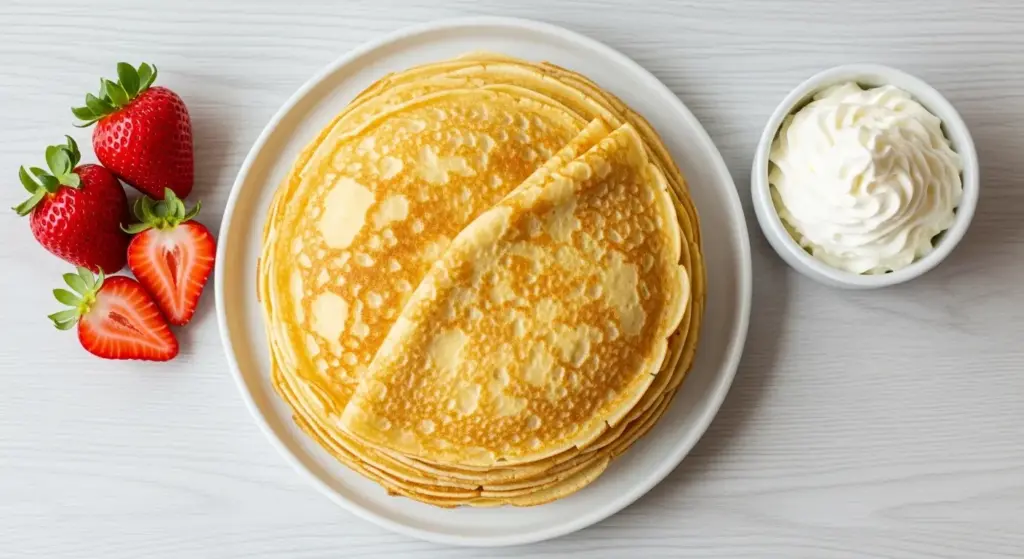
Crepes are a blank canvas waiting for your creativity, adapting seamlessly to sweet or savory preparations throughout the day.
For sweet crepes, try these delicious combinations:
- Fresh berries with whipped cream and a dusting of powdered sugar
- Nutella spread with sliced bananas and a drizzle of caramel sauce
- Lemon juice and granulated sugar for a classic French preparation
- Strawberry jam with cream cheese and a sprinkle of cinnamon
- Caramelized apples with vanilla ice cream
- Ricotta cheese sweetened with honey and topped with fresh figs
- Dark chocolate chips that melt inside, finished with chopped hazelnuts
For savory crepes, consider these options:
- Ham and Gruyère cheese with a simple salad
- Sautéed mushrooms with garlic and fresh thyme
- Scrambled eggs with crispy bacon and cheddar
- Smoked salmon with cream cheese, capers, and fresh dill
- Roasted vegetables with goat cheese
- Spinach and ricotta with marinara sauce
- Chicken with béchamel sauce and Swiss cheese
These also work wonderfully alongside classic deviled eggs for an elegant brunch.
Variations to Try
Once you’ve mastered the basic technique, experimenting with different flavors and styles keeps crepe-making exciting and allows you to customize them for any occasion.
Try these creative variations:
- Chocolate Crepes: Add 3 tablespoons of cocoa powder to the batter and reduce flour by 3 tablespoons for rich, chocolate crepes perfect for dessert
- Buckwheat Crepes: Replace half the all-purpose flour with buckwheat flour for authentic savory galettes with a nutty flavor
- Lemon Zest Crepes: Add 1 tablespoon of fresh lemon zest to the batter for bright, citrusy crepes
- Herb Crepes: Stir in 2 tablespoons of minced fresh herbs like chives, parsley, or dill for savory preparations
- Orange Crepes: Replace the vanilla with 1 tablespoon orange zest and 2 tablespoons orange liqueur for Crepes Suzette
- Cinnamon Crepes: Add 1 teaspoon ground cinnamon to the batter for warm, spiced crepes
- Whole Wheat Crepes: Substitute half the all-purpose flour with whole wheat flour for added fiber and nuttiness
- Almond Crepes: Replace vanilla with 1/2 teaspoon almond extract and add 2 tablespoons ground almonds
- Matcha Crepes: Whisk 1 tablespoon matcha powder into the batter for beautiful green crepes
You might also enjoy: German Pancake Recipe
Storage and Reheating
Proper storage techniques ensure your crepes stay fresh and maintain their delicate texture for days or even months.
Follow these storage guidelines:
- Room temperature: Stack cooled crepes with wax or parchment paper between each one, then wrap tightly in plastic wrap; use within 2 hours
- Refrigerator: Place stacked crepes in an airtight container or zip-top bag with parchment between layers; they’ll keep for up to 3 days
- Freezer: Layer crepes with parchment paper, place in a freezer-safe bag, press out excess air, and freeze for up to 2 months
- Reheating from fridge: Warm individual crepes in a dry skillet over low heat for 10-15 seconds per side, or microwave for 10-15 seconds
- Reheating from frozen: Thaw overnight in the refrigerator, then reheat as directed above, or microwave frozen crepes for 20-30 seconds
- Batter storage: Keep unused batter in the refrigerator for up to 2 days; whisk well before using and thin with water if needed
- Warming for a crowd: Stack crepes on an oven-safe plate, cover with foil, and warm in a 200°F (95°C) oven for 10-15 minutes
This technique works wonderfully in French toast casserole as well.
Nutritional Facts
Understanding the nutritional content helps you make informed decisions about serving sizes and accompaniments.
Per crepe (based on 12 crepes):
- Calories: 107
- Total Fat: 4g
- Saturated Fat: 2g
- Cholesterol: 70mg
- Sodium: 75mg
- Total Carbohydrates: 13g
- Dietary Fiber: 0g
- Sugars: 3g
- Protein: 4g
- Calcium: 52mg
- Iron: 1mg
Note that these values are for plain crepes only and don’t include fillings or toppings. Nutritional content will vary based on what you add. Using whole milk versus skim milk, or adding extra butter for cooking, will also affect the totals.
Read Also: Easy French Toast Recipe
Health Benefits of Key Ingredients
While crepes are often considered an indulgent treat, the basic ingredients provide several nutritional benefits that contribute to a balanced diet.
The main ingredients offer these health advantages:
- Eggs: Excellent source of high-quality protein, vitamin D, vitamin B12, and choline, which supports brain health and development
- Milk: Provides calcium for strong bones and teeth, plus vitamin D, protein, and potassium for muscle and nerve function
- Flour: Supplies carbohydrates for energy, along with some B vitamins and iron, especially if you use enriched flour
- Butter: Contains fat-soluble vitamins A, D, E, and K, which are essential for various bodily functions when consumed in moderation
When you incorporate whole wheat flour or add fruits and vegetables as toppings, you increase the fiber content and add important vitamins and antioxidants. Making crepes at home also allows you to control the sugar content and choose higher-quality ingredients compared to store-bought or restaurant versions.
For a lighter option, try: Gluten Free Pancake Recipe
Frequently Asked Questions
1. Can I make crepe batter ahead of time?
Absolutely, and in fact, the batter benefits from resting. You can prepare the batter up to 24 hours in advance and store it covered in the refrigerator. Just give it a good stir before using, as some separation is normal. If the batter seems too thick after sitting, thin it with a tablespoon or two of milk or water until it reaches heavy cream consistency.
2. Why do my crepes keep tearing?
Tearing usually happens for a few reasons. The batter might be too thin, so try adding a tablespoon of flour. Your pan might be too hot, causing the crepes to cook too quickly and become brittle. Make sure you’re cooking over medium-low heat and letting each crepe cook until the edges look dry before flipping.
3. What’s the difference between crepes and pancakes?
Crepes are much thinner than pancakes and contain no leavening agents like baking powder or baking soda. Pancake batter is thicker and produces fluffy, risen pancakes. Crepe batter has a higher ratio of liquid to flour, creating a thin, pourable consistency that results in delicate, paper-thin pancakes.
4. Can I make crepes without a crepe pan?
Yes, you absolutely can use a regular nonstick skillet. An 8-inch nonstick pan works perfectly for making crepes. While a dedicated crepe pan with its low, sloped sides makes flipping easier, it’s not necessary. Just make sure whatever pan you use has a flat bottom and good nonstick surface.
5. How do I know when to flip the crepe?
The crepe is ready to flip when the surface looks dry and matte instead of shiny and wet, typically after 30-60 seconds. The edges will start to look lacy and will pull away from the sides of the pan slightly. You should see some golden spots when you peek underneath with a spatula.
Read Also: Kodiak Pancake Recipe
Basic Crepe Recipe

Equipment
- Blender - or whisk for mixing manually
- 8-inch nonstick skillet - or crepe pan
- Measuring cups and spoons
- Small ladle - or 1/4 cup measuring cup
- Rubber spatula - thin, for flipping
- Large mixing bowl - if not using a blender
- Wire cooling rack - for stacking finished crepes
- Pastry brush - or paper towel for greasing
- Small bowl for melted butter
Ingredients
- 2 cups all-purpose flour - 250g
- 4 large eggs
- 2 cups whole milk - 480ml
- 1/2 cup water - 120ml
- 4 tablespoons unsalted butter - 56g, melted and cooled
- 2 tablespoons granulated sugar
- 1/4 teaspoon salt
- 1 teaspoon vanilla extract - optional for sweet crepes
For Serving (Sweet)
- fresh berries - for topping
- whipped cream - for topping
- powdered sugar - for dusting
- Nutella - for spreading
- sliced bananas
- lemon juice
- caramel sauce - for drizzling
- dark chocolate chips
- chopped hazelnuts - for garnish
For Serving (Savory)
- ham
- Gruyère cheese - shredded
- sautéed mushrooms - with garlic and fresh thyme
- scrambled eggs
- crispy bacon
- cheddar cheese - shredded
- smoked salmon
- cream cheese
- capers
- fresh dill
- roasted vegetables
- goat cheese
- spinach
- ricotta cheese
- marinara sauce
Instructions
- Place flour, eggs, milk, water, sugar, and salt in blender. Add cooled melted butter and vanilla if using. Blend 15-20 seconds until smooth.
- Cover and refrigerate batter for at least 30 minutes, or up to 24 hours for best results.
- Place 8-inch nonstick skillet over medium-low heat and preheat for about 2 minutes.
- Lightly brush pan with melted butter using a pastry brush or folded paper towel.
- Pour about 1/4 cup batter into center of pan, then immediately swirl pan in circular motion to spread batter thinly and evenly.
- Cook undisturbed for 30-60 seconds until surface looks matte and edges begin to pull away from pan.
- Slide thin spatula under edge to loosen, then flip crepe in one smooth motion. Cook second side for 15-30 seconds.
- Slide finished crepe onto wire cooling rack. Lightly butter pan again and repeat with remaining batter.
Notes
- Batter consistency: Should be like heavy cream – thin enough to swirl easily but not watery. Add 1-2 tablespoons milk or water if too thick.
- Don’t skip resting time: This allows flour to hydrate properly and makes a noticeable difference in texture.
- First crepe is a test: The first crepe is almost always wonky as the pan establishes the right temperature – consider it a cook’s treat.
- Temperature control: Medium-low heat is crucial. If crepes cook too fast or develop crispy edges, reduce heat slightly.
- Make ahead: Batter can be refrigerated for up to 24 hours. Cooked crepes stack well with parchment between layers.
- Freezing instructions: Layer cooled crepes with parchment paper, place in freezer bag, and freeze for up to 2 months.
- Reheating: Warm in dry skillet over low heat for 10 seconds per side, or microwave for 10-15 seconds.
- Savory variation: Omit the sugar and vanilla for savory crepes, or add fresh herbs to the batter.
- Swirling technique: Work quickly – the batter sets fast. Practice the circular wrist motion to spread batter evenly.
- Gluten-free option: Substitute all-purpose flour with a good gluten-free flour blend; you may need to adjust liquid slightly.
Final Thoughts
Mastering a basic crepe recipe opens up a world of culinary possibilities, from elegant breakfast spreads to impressive desserts and everything in between. With just a handful of simple ingredients and a little practice, you’ll be creating restaurant-quality crepes that friends and family will rave about.
The beauty of crepes lies in their versatility and simplicity. Once you’ve nailed the technique, you can whip up a batch anytime the craving strikes, filling them with whatever sounds delicious. I hope this recipe becomes a staple in your kitchen, bringing a touch of French elegance to your everyday meals.
Recommended:
- Classic French Toast Recipe
- Easy Waffle Recipe
- Belgian Waffle Recipe
- Buttermilk Pancake Recipe
- Old Fashioned Pancake Recipe
- German Pancake Recipe
- French Toast Casserole Recipe
- Homemade Granola Recipe
- Classic Deviled Eggs Recipe
- Easy Granola Recipe