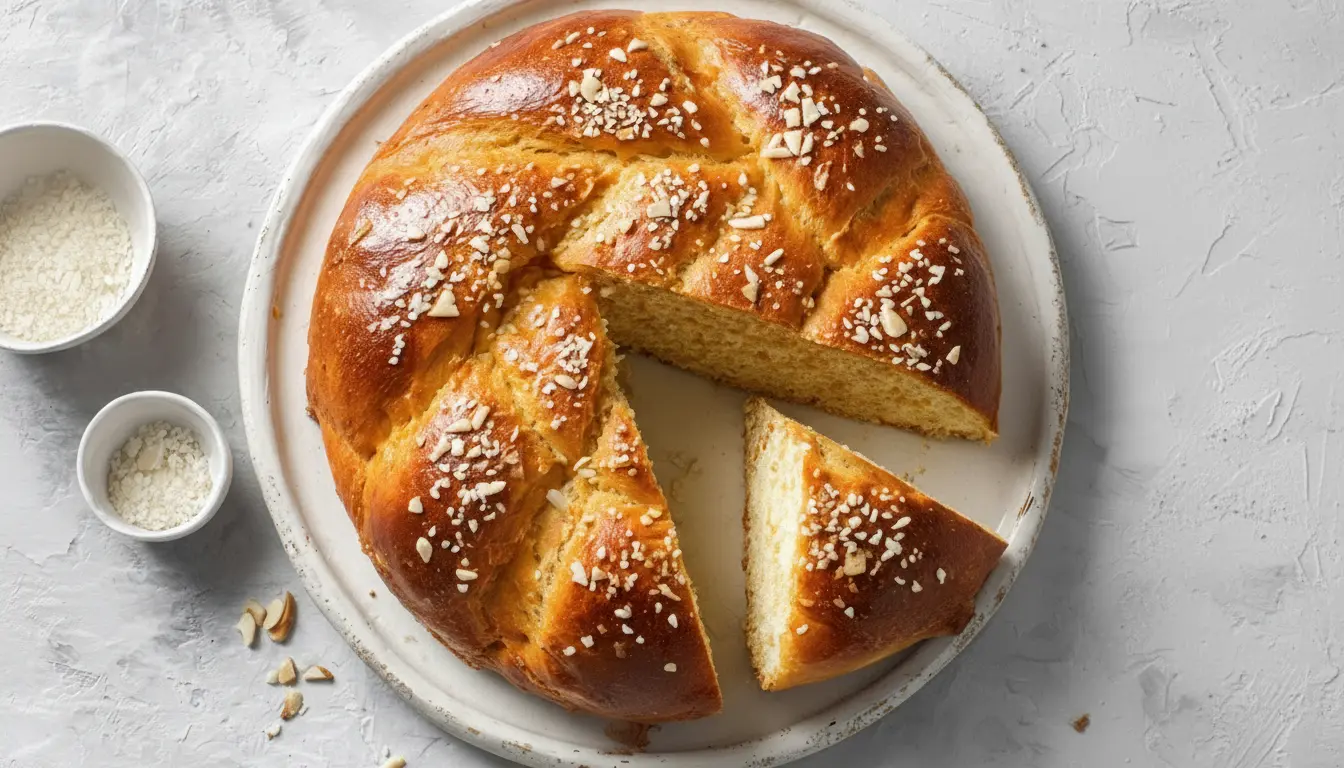
Vasilopita Bread

Vasilopita is a traditional Greek New Year's bread rich with butter, fragrant orange zest, and vanilla, topped with toasted sesame seeds and hiding a lucky coin inside. This sweet, aromatic loaf has graced Greek holiday tables for centuries, bringing together family and the promise of good fortune with every golden, pillowy slice.
Equipment
- Stand mixer with dough hook attachment - Or mix and knead by hand
- Large mixing bowls - At least 2 needed
- Measuring cups and spoons
- Kitchen thermometer - For checking liquid temperature
- Microplane or fine grater - For orange zest
- Clean kitchen towels
- 10-inch round cake pan or springform pan - 25cm; springform pan makes removal easier
- Pastry brush - For egg wash and honey-butter glaze
- Sharp knife or razor blade - For scoring decorative patterns
- Wire cooling rack
Ingredients
For the Yeast Mixture
- 1/4 cup warm water - 60ml, 110°F/43°C
- 2 1/4 tsp active dry yeast - 1 packet
- 1 tsp granulated sugar
- 1 cup whole milk - 240ml, warmed to 110°F/43°C
- 1 cup all-purpose flour - 125g
For the Dough
- 6-7 cups all-purpose flour - 750–875g, plus more for kneading
- 3/4 cup granulated sugar - 150g
- 1 tsp salt
- 1/2 cup unsalted butter - 115g, melted and cooled
- 4 large eggs - room temperature
- 1 large egg yolk - room temperature
- 2 tbsp orange zest - from about 2 medium oranges
- 2 tsp pure vanilla extract
- 1/4 tsp ground mahlepi - optional, but traditional
- 1/4 tsp ground mastic - optional, but traditional
For Assembly and Topping
- 1 large egg - beaten, for egg wash
- 3 tbsp sesame seeds
- 1/2 cup blanched sliced almonds - 75g, optional, for decorating
- 1 clean coin wrapped in aluminum foil
- 2 tbsp unsalted butter - melted, for brushing after baking
- 1 tbsp honey - for glazing
Instructions
- Combine warm water (110°F), yeast, and 1 tsp sugar in a large bowl; let sit 5 minutes until foamy. Whisk in the warmed milk and 1 cup flour until smooth, then cover and proof for 45–60 minutes until doubled and spongy.
- Whisk together 6 cups flour, sugar, and salt in a large bowl, then rub in the orange zest with your fingertips to release the oils. Add mahlepi and mastic if using, then set aside.
- Whisk together the cooled melted butter, 4 whole eggs, 1 egg yolk, and vanilla extract in a medium bowl until light and slightly frothy, about 1 minute.
- Transfer the proofed yeast mixture to the stand mixer bowl, add the wet ingredients, and mix on low. Gradually add the flour mixture one cup at a time until the dough pulls away from the sides and is soft and slightly sticky.
- Increase speed to medium and knead for 8–10 minutes (12–15 by hand) until the dough is smooth, elastic, and springs back when poked. Add flour sparingly only if the dough is excessively sticky.
- Shape the dough into a ball, place in a lightly oiled bowl, turn to coat, and cover tightly with plastic wrap and a kitchen towel. Let rise in a warm spot for 1.5–2 hours until doubled in size.
- Punch down the dough, knead briefly, then shape into a smooth round and place in a generously buttered 10-inch pan. Make a small incision in the bottom, insert the foil-wrapped coin, and press the dough to seal.
- Cover loosely and let rise 45–60 minutes until puffy; preheat oven to 350°F (175°C) during the last 20 minutes. Brush with egg wash, sprinkle with sesame seeds, and decorate with almonds if desired.
- Bake on the center rack for 45–55 minutes, rotating halfway, until deep golden brown and the internal temperature reaches 190–195°F (88–91°C). Tent with foil if the top browns too quickly after 30 minutes.
- Cool in the pan 10 minutes, then transfer to a wire rack and immediately brush with the combined melted butter and honey. Allow to cool completely, at least 1 hour, before slicing.
Notes
- Check liquid temperatures with a thermometer — 110°F (43°C) is ideal for yeast activation; too hot kills yeast, too cool won't activate it.
- If you don't have mahlepi or mastic, substitute 1/4 tsp ground cardamom or a few drops of almond extract for a similar warm, aromatic flavor.
- Wrap the coin in multiple layers of foil and smooth all edges before inserting to prevent any metallic taste from transferring to the bread.
- To create a warm proofing environment, heat your oven to 200°F for 2 minutes, then turn it off and place the covered dough inside.
- Do not rush the rise times — proper proofing develops the best flavor and a light, airy crumb structure.
- Make-ahead tip: After the first rise, shape the dough with the coin, place in the pan, cover tightly, and refrigerate overnight. The next day, let it come to room temperature and rise (1–2 hours) before baking.
- The bread tastes even better the day after baking as the flavors develop further.
- Store completely cooled bread wrapped tightly in plastic wrap at room temperature for up to 4 days, or freeze individual slices for up to 3 months.
- Refresh day-old slices by warming in a 300°F oven for 5–7 minutes, or toast in a buttered skillet for a crispy exterior.
- Always warn guests about the hidden coin before they bite into their slice — and consider giving a small prize to whoever finds it!