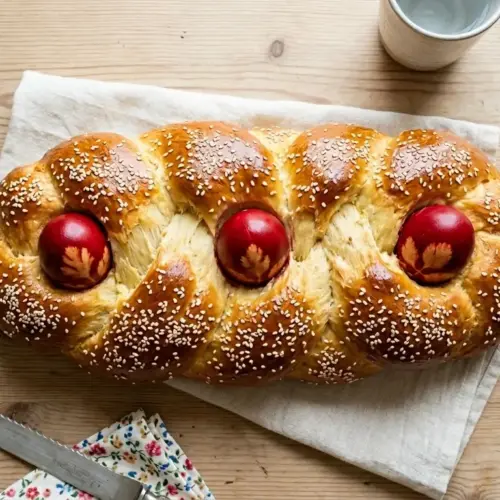
Tsoureki (Greek Easter Bread)

This traditional Greek sweet bread is soft, braided, and fragrant with the distinctive scent of mahlab and mastic. Enriched with butter, eggs, and milk, it produces a cloud-soft crumb and a gorgeous stringy, pull-apart texture that stays tender for days.
Equipment
- Stand mixer with dough hook attachment - Strongly recommended over kneading by hand
- Large mixing bowl
- Small bowl - For activating the yeast and preparing the egg wash
- Bench scraper - For dividing dough cleanly
- Half-sheet baking pan - Heavy-duty aluminum recommended for even heat distribution
- Parchment paper
- Plastic wrap - For covering dough during rising
- Clean kitchen towel - Alternative to plastic wrap
- Pastry brush
- Kitchen scale - For accurately dividing the dough into equal strands
- Instant-read thermometer - To verify milk temperature and baked doneness
- Wire cooling rack
- Mortar and pestle or spice grinder - For grinding mahlab and mastic (optional but recommended)
Ingredients
- 4 cups all-purpose flour - 500g, plus more for dusting
- 1 packet active dry yeast - 2¼ teaspoons or 7g
- ½ cup whole milk - 120ml, warmed to 110°F (43°C)
- ½ cup granulated sugar - 100g, divided (reserve 1 teaspoon for activating yeast)
- 3 large eggs - at room temperature
- ½ cup unsalted butter - 115g, softened to room temperature
- 1 teaspoon vanilla extract
- 1 teaspoon mahlab - 3g, finely ground
- ¼ teaspoon mastic resin - 1g, ground
- 1 large orange - zest of 1 orange
- ½ teaspoon salt
Egg Wash
- 1 large egg
- 1 tablespoon whole milk
Optional Toppings
- 2 tablespoons sesame seeds - or slivered almonds
- 3 red hard-boiled eggs - for traditional Easter presentation
Instructions
- Activate the yeast by combining warm milk (105-115°F) with 1 teaspoon sugar, sprinkle yeast over top, let stand 5-10 minutes until foamy.
- Prepare mastic by freezing crystals for 10-15 minutes, then grind with a pinch of sugar until fine powder forms.
- In stand mixer bowl, combine flour, remaining sugar, salt, ground mahlab, mastic, and orange zest. Whisk briefly to distribute evenly.
- Add room-temperature eggs, activated yeast mixture, and vanilla. Mix on low speed for 3-4 minutes until rough, shaggy dough forms.
- With mixer running on low, add softened butter one tablespoon at a time. Once incorporated, increase speed to medium and knead 10-12 minutes until smooth, glossy, and elastic. Perform windowpane test to confirm gluten development.
- Place dough in oiled bowl, cover, and let rise in warm spot for 1.5-2 hours until doubled in size.
- Turn dough onto lightly floured surface, gently deflate, and divide into 3 equal pieces (about 255g each). Roll each into an 18-20 inch rope.
- Pinch ends of ropes together and braid three-strand style from top to bottom. Tuck ends underneath, transfer to parchment-lined baking sheet.
- Cover loosely and let rise for 45-60 minutes until puffy but not doubled.
- Preheat oven to 350°F (175°C). Whisk together egg and milk for egg wash. Brush entire surface of risen loaf gently.
- Press red eggs into braids if using, sprinkle with sesame seeds or almonds. Bake for 30-35 minutes until deep golden brown. Tent with foil if browning too quickly.
- Let rest on baking sheet for 10 minutes, then transfer to wire rack to cool completely (at least 30 minutes) before slicing.
Notes
- Room temperature eggs and butter: Take them out of the fridge at least 1 hour before baking. Cold ingredients interfere with gluten development and make butter difficult to incorporate smoothly.
- Freshly ground mahlab: Buy whole seeds and grind just before use. Pre-ground mahlab loses its aroma quickly and can turn rancid, leaving the bread with a flat or bitter taste.
- Freeze mastic before grinding: Without freezing, the resin becomes sticky and gummy. A few minutes in the freezer makes it brittle and easy to grind to a fine powder.
- Don't skip the windowpane test: This is the most reliable indicator that gluten is properly developed. Skipping this step is the most common reason tsoureki comes out dense rather than fluffy.
- Avoid over-proofing during the second rise: Watch the loaf carefully after shaping. It should puff and look full, but not double. Over-proofed dough loses braid definition and may collapse in the oven.
- Make-ahead option: After kneading, cover the bowl tightly and refrigerate overnight instead of doing the first rise at room temperature. The next morning, let it sit at room temperature for about an hour before shaping.
- Storage: Wrap the cooled loaf tightly in plastic wrap or store in a sealed bag. It will stay soft and fresh for 3-4 days at room temperature.
- Freezing: Tsoureki freezes beautifully. Slice the cooled loaf, freeze slices individually, then transfer to a freezer-safe bag. Thaw only what you need.
- Day-old use: Slightly stale tsoureki makes extraordinary French toast or can be toasted with butter and honey. Wrap in foil and warm at 300°F for 10 minutes to revive.
- Substitution without mastic: If you cannot source mastic, you can skip it entirely without losing the fundamental character of the bread. For mahlab, a possible substitute is 1/4 teaspoon almond extract combined with a pinch of cardamom.