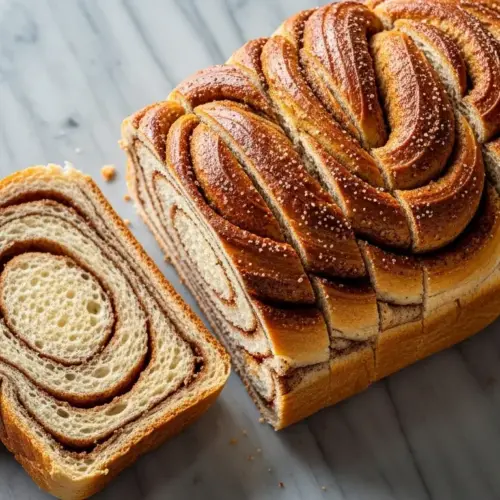
Sweet Sourdough Bread

This sweet sourdough bread brings together the tangy depth of traditional sourdough with a soft, pillowy crumb enriched with milk, butter, and sugar — all swirled with a warm cinnamon-sugar filling. Naturally leavened and incredibly versatile, it's perfect for breakfast toast, French toast, or simply enjoying with butter straight from the oven.
Equipment
- Digital kitchen scale - For accurate measurements
- Large mixing bowl - For the dough
- 9x5-inch loaf pan - For baking the bread
- Bench scraper or dough scraper - For handling sticky dough
- Rolling Pin - For shaping the dough rectangle
- Pastry brush - For applying egg wash
- Clean kitchen towels or plastic wrap - For covering dough during rises
- Wire cooling rack - For cooling the baked loaf
- Stand mixer with dough hook - (optional) Hand-kneading works well too
- Instant-read thermometer - (optional) To check dough and bread internal temperature
- Parchment paper - (optional) For easy removal from pan
Ingredients
For the Dough
- 100 g active sourdough starter - 1/2 cup; bubbly and at peak activity
- 240 ml whole milk - 1 cup; warmed to room temperature
- 50 g granulated sugar - 1/4 cup
- 50 g unsalted butter - 3.5 tablespoons; melted and slightly cooled
- 500 g bread flour - 4 cups; plus more for dusting
- 10 g fine sea salt - 2 teaspoons
- 1 large egg - beaten, for egg wash
For the Cinnamon Sugar Filling
- 60 g unsalted butter - 5 tablespoons; softened to room temperature
- 100 g brown sugar - 1/2 cup; packed
- 15 g ground cinnamon - 2 tablespoons
- salt - pinch
Instructions
- Feed your sourdough starter 4–6 hours before mixing, using a 1:1:1 ratio of starter, flour, and water. Place in a warm spot (75–80°F / 24–27°C) until doubled, bubbly, and domed on top.
- Whisk together warm milk, active starter, and sugar until the starter is dissolved and slightly frothy, then whisk in melted butter. Add bread flour and salt, mixing until all flour is hydrated and no dry patches remain — the dough will look shaggy.
- Cover the bowl with a damp towel or plastic wrap and rest the dough at room temperature for 30–60 minutes. The dough will become smoother and more cohesive, making kneading much easier.
- Knead on a lightly floured surface for 8–10 minutes by hand (or 5–7 minutes in a stand mixer on medium) until smooth, elastic, and passing the windowpane test. Shape into a ball, place in a lightly greased bowl, and turn to coat.
- Cover and let the dough rise in a warm, draft-free spot (75–78°F / 24–26°C) for 6–8 hours until doubled in size, puffy, and slowly springing back when gently pressed. Timing varies with kitchen temperature.
- Combine softened butter, brown sugar, cinnamon, and a pinch of salt in a small bowl, mixing with a fork until a smooth, spreadable paste forms. Set aside at room temperature.
- Gently deflate the risen dough, then roll it out on a lightly floured surface into a 9×12–14 inch rectangle; spread the cinnamon filling evenly, leaving a 1/2-inch border along one long edge, then tightly roll into a log and pinch the seam and ends closed.
- Place the log seam-side down in a greased 9×5-inch loaf pan, cover loosely, and proof at room temperature for 2–4 hours until the dough rises about 1 inch above the rim and slowly springs back when pressed.
- Preheat the oven to 350°F (175°C) with a rack in the center about 30 minutes before baking. Gently brush the top of the proofed loaf with beaten egg wash and optionally sprinkle with coarse sugar.
- Bake for 45–50 minutes, rotating halfway through, until deep golden brown and an instant-read thermometer reads 190–200°F (88–93°C) in the center; tent loosely with foil if the top browns too quickly.
- Cool in the pan for 10 minutes, then transfer to a wire rack and cool for at least 1 hour before slicing with a serrated knife — cutting too soon results in a gummy crumb.
Notes
- Active starter is essential: Your starter must be at peak activity — bubbly, doubled, and domed. Test by dropping a spoonful in water; it should float.
- Windowpane test: Don't skip this check for gluten development. Stretch a small piece of dough between your fingers — it should form a thin, translucent membrane without tearing.
- Temperature matters: Dough ferments faster in warm kitchens (above 75°F) and slower in cool ones. Adjust bulk fermentation time accordingly — it can take 4–5 hours in a warm kitchen or up to 10 hours in a cool one.
- Roll tightly: A tight roll prevents gaps in the cinnamon swirl and ensures beautiful, even layers throughout the loaf.
- Don't over-proof: The second rise is done when the dough barely springs back when pressed. Over-proofed dough will collapse in the oven.
- Same-day shortcut: Feed your starter at a higher ratio (1:3:3) and keep dough in a warm spot (80–85°F) to reduce total fermentation time to 4–6 hours, though flavor will be less complex.
- Using discard: If using sourdough discard instead of active starter, add 1.5 teaspoons of instant yeast with the flour to ensure a proper rise.
- Storage: Store in an airtight container at room temperature for up to 4 days. Do not refrigerate — it dries out the bread faster.
- Freezing: Slice the cooled loaf, separate slices with parchment paper, and freeze in a bag for up to 3 months. Toast directly from frozen or thaw at room temperature for 30 minutes.
- Variations: Try adding soaked raisins, mini chocolate chips, or orange zest to the filling — or swap 1 tsp cinnamon for cardamom for a Scandinavian-inspired twist.