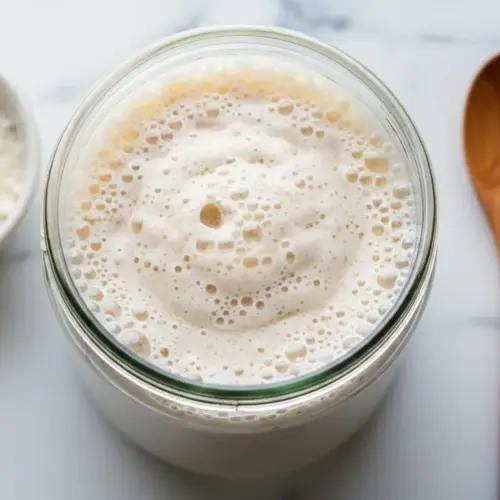
Sourdough Starter from Scratch

This living culture of wild yeast and beneficial bacteria becomes the heart of all your sourdough baking adventures, from crusty artisan loaves to fluffy pancakes. The process takes about 7 days but requires only 5-10 minutes of active time daily.
Equipment
- Large glass jar or container - at least 1-quart capacity, clear sides to see bubbles
- Kitchen scale - for accurate measurements
- Wooden spoon or silicone spatula - for mixing
- Breathable cover - clean dish towel, coffee filter, or loose lid
- Rubber band or string - to secure the cover
- Thermometer - optional, for checking water temperature
- Marker or rubber band - for marking starter height on jar
- Small bowl - for discarding excess starter
Ingredients
- 1 cup whole wheat flour - 120g, preferably organic
- 0.5 cup filtered water - 120g, lukewarm (about 80°F/27°C)
Days 3-7+ (Daily Feedings)
- 1 scant cup all-purpose flour - 113g, or bread flour
- 0.5 cup filtered water - 113g, lukewarm
Total Quantities for 7 Days
- 5 cups all-purpose flour - approximately 600g, or bread flour
- 1 cup whole wheat flour - 120g, or rye flour
- 3.5 cups filtered water - approximately 840g
Instructions
- Day 1 - Initial Mix: Combine 120g whole wheat flour with 120g lukewarm filtered water in a glass jar. Stir vigorously for 1 minute until no dry pockets remain. Scrape down sides, cover loosely with breathable cloth, mark height, and place in warm spot (70-75°F/21-24°C) for 24 hours.
- Day 2 - First Feeding: Discard half the starter (about 113g). Add 113g all-purpose flour and 113g lukewarm water to remaining starter. Stir vigorously for 1-2 minutes until smooth. Mark new height, cover loosely, and return to warm spot for 24 hours.
- Day 3 - Establishing Routine: Discard half the starter (113g). Feed with 113g all-purpose flour and 113g lukewarm water. Mix thoroughly for 1 minute until smooth. Mark height, cover loosely, and check after 12 hours for bubble formation and rise.
- Day 4 - Building Strength: Discard half the starter. Add 113g all-purpose flour and 113g lukewarm water. Stir vigorously for 1-2 minutes. Clean jar sides, mark new level, cover, and observe activity over the next 24 hours.
- Day 5 - Increasing Activity: Perform daily discard of half the starter. Feed with 113g flour and 113g lukewarm water. Mix thoroughly for 1-2 minutes. Mark height, cover loosely, and check every few hours to see how quickly it rises.
- Day 6 - Near Maturity: Discard half the starter. Feed with 113g flour and 113g lukewarm water. Stir well for 1-2 minutes. Mark height carefully and watch closely to see when it doubles. Perform float test by dropping a small spoonful into room temperature water.
- Day 7 and Beyond - Ready to Use: Continue daily feedings using the discard-and-feed method. Use starter when at its peak (doubled and bubbly). Reserve at least 113g after using for a recipe, then feed with 113g flour and 113g water. Refrigerated starters need feeding only once per week.
Notes
- Use the same feeding schedule every day during the first week for consistency.
- If your house is cold, place the jar in an oven with just the light on, or on top of the refrigerator for optimal warmth.
- Always use lukewarm water (about 80°F/27°C), never hot water which can kill the yeast.
- Stir vigorously during feedings to incorporate oxygen which the yeast needs to thrive.
- Don't seal the jar tightly as the starter needs to breathe and can build up pressure.
- If you see a layer of clear or dark liquid (hooch) on top, your starter is hungry - just stir it back in.
- A strong alcohol or vinegar smell means the starter needs to be fed more frequently.
- Mold (pink, green, or fuzzy white) means you should discard everything and start over.
- Save your discard after day 5 for pancakes, waffles, crackers, and other discard recipes.
- Whole wheat or rye flour feedings can give a sluggish starter a boost of activity.
- Use filtered or bottled water in areas with heavily chlorinated tap water.
- Transfer to a clean jar every 3-4 days to prevent buildup of bacteria on the sides.