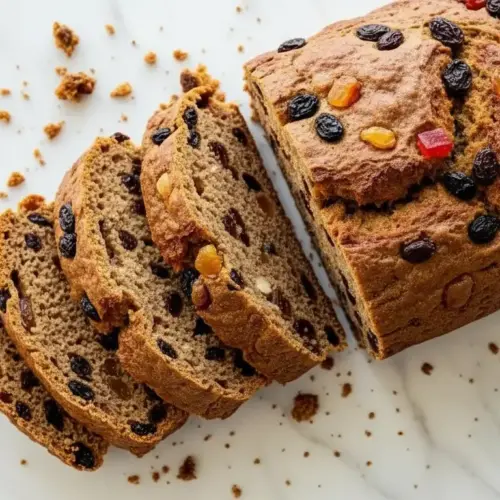
Manna Bread (Essene Bread)

This ancient sprouted grain bread, also known as Essene bread, dates back thousands of years and requires just a handful of simple ingredients. Made entirely from whole sprouted wheat berries ground into a paste and baked low and slow, manna bread delivers a dense, moist, naturally sweet loaf that's free from flour, yeast, and preservatives. The sprouting process enhances digestibility, boosts nutrient bioavailability, and creates a uniquely satisfying bread that connects you to one of humanity's oldest culinary traditions.
Equipment
- Wide-mouth glass jar (quart-sized) - Or sprouting jar with mesh lid
- Cheesecloth or fine mesh lid - For covering the sprouting jar
- Rubber band - To secure cheesecloth over jar
- Food processor - High-powered recommended for grinding sprouts into paste
- Baking sheet - Or loaf pan
- Parchment paper - For lining the baking sheet
- Large bowl - For rinsing sprouts
- Wire cooling rack - For cooling the loaf after baking
- Oven thermometer - (optional) Recommended to verify low baking temperature accuracy
Ingredients
Sweet Version
- 2 cups organic wheat berries - 480g; hard red winter wheat works best; must be organic to ensure germination
- 1/2 tsp sea salt
- 1 cup raisins - optional; for sweet version
- 1 tsp ground cinnamon - optional; for sweet version
- filtered water - for sprouting; approximately 4 cups for soaking
Savory Version
- 2 cups organic wheat berries - 480g; hard red winter wheat works best
- 1 tsp sea salt
- 2-3 tbsp fresh rosemary or mixed herbs - optional; finely chopped
- 1/4 cup chopped walnuts or sunflower seeds - optional; about 30g
Instructions
- Place 2 cups of wheat berries in a wide-mouth quart jar, rinse well, then fill with cool filtered water (about twice the volume of berries). Secure a cheesecloth or mesh lid with a rubber band and soak at room temperature for 8–12 hours or overnight.
- Drain all soaking water through the mesh lid, rinse berries thoroughly, then drain completely by inverting the jar at a 45-degree angle. Place in a dark cupboard and repeat this rinse-and-drain process twice daily, morning and evening.
- Continue rinsing for 2–3 more days until small white tails emerge that are roughly the same length as the berry (about 1/4 inch or 6mm). Sprouts should taste sweet and fresh — skip the final rinse before processing so they aren't too wet.
- Transfer sprouted berries to a food processor, add sea salt and any optional ingredients, then process on high for 3–5 minutes, scraping down sides every minute, until the mixture forms a smooth, sticky paste resembling thick cookie dough.
- Line a baking sheet with parchment paper and lightly oil it, then turn dough out and shape with wet hands into a flat oval or rectangle about 1 to 1.5 inches (2.5–4cm) thick, keeping the thickness uniform for even baking.
- Preheat oven to 275°F (135°C) and bake the loaf on the center rack for 2.5 to 3 hours, until the exterior is firm and lightly browned and an internal temperature of about 180°F (82°C) is reached. For a crustier finish, raise temperature to 300°F (150°C) for the final 30 minutes.
- Let the loaf rest on the baking sheet for 10 minutes, then transfer to a wire cooling rack and cool completely for at least 1 hour before slicing with a sharp serrated knife — the bread firms up considerably as it cools.
Notes
- Use organic wheat berries only — conventionally grown berries may be treated with herbicides that prevent germination.
- Rinse sprouts at consistent times twice daily (morning and evening) to establish a routine and avoid mold.
- Don't over-sprout: tails longer than the berry itself result in a bitter, grassy flavor — aim for 1/4 inch tails.
- Skip the final rinse before processing so sprouts retain enough moisture for proper dough consistency.
- If the dough is too dry or crumbly after processing, add 1–2 tablespoons of water and process again.
- Use an oven thermometer to verify your oven's temperature — the low baking temperature is critical to proper texture.
- Store at room temperature for 3–4 days wrapped in parchment inside a sealed bag, refrigerate for up to 4 weeks, or freeze individual slices for up to 6 months.
- Make multiple loaves at once since the sprouting time is the same whether you sprout for one or three loaves.
- This recipe also works with spelt berries, rye berries, or kamut — sprouting times may vary slightly by grain.
- Manna bread is not gluten-free; those with celiac disease should avoid it, though the sprouting process reduces gluten content by approximately 47% compared to flour-based bread.