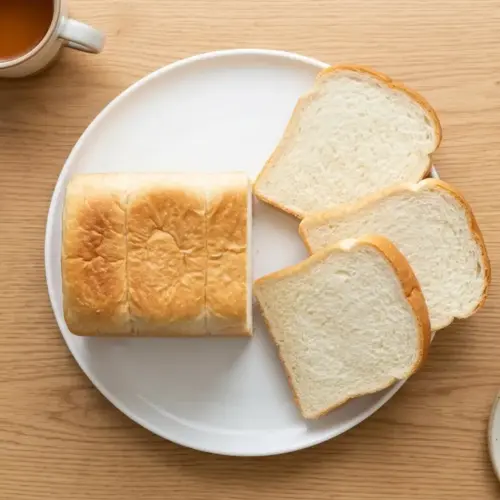
Japanese Milk Bread

This Japanese Milk Bread is pillowy soft, faintly sweet, and stays fresh for days thanks to the tangzhong method—a simple cooked flour paste that keeps the crumb tender and moist.
Equipment
- Stand mixer with dough hook
- 9x5-inch loaf pan
- Small saucepan - for cooking the tangzhong
- Digital kitchen scale - recommended for accuracy
- Instant-read thermometer - for checking internal temperature
- Mixing bowls
- Plastic wrap - or damp kitchen towel
- Pastry brush - for the egg wash
Ingredients
- 1/3 cup bread flour - 43g, for the tangzhong
- 1/2 cup whole milk - 120ml, for the tangzhong
- 1/4 cup water - 60ml, for the tangzhong
For the Dough
- 2 3/4 cup bread flour - 350g, for the dough
- 1/4 cup granulated sugar - 50g
- 1 teaspoon fine sea salt - 6g
- 2 1/4 teaspoon instant yeast - 7g
- 1 large egg - room temperature
- 1/3 cup whole milk - 80ml, room temperature
- 4 tablespoon unsalted butter - 56g, softened and cubed
For the Egg Wash
- 1 egg yolk
- 1 tablespoon whole milk
Instructions
- Whisk together 1/3 cup (43g) bread flour, 1/2 cup (120ml) milk, and 1/4 cup (60ml) water until smooth. Cook over medium-low heat while whisking constantly for 2-3 minutes until thickened to a pudding-like paste. Transfer to a bowl, cover with plastic wrap directly on the surface, and cool to room temperature.
- In a stand mixer bowl with dough hook, combine 2 3/4 cups (350g) bread flour, sugar, salt, and instant yeast. Add the cooled tangzhong, egg, and 1/3 cup (80ml) milk. Mix on low speed for 1 minute until a shaggy dough forms, then increase to medium and knead for 8-10 minutes until smooth and pulling away from the bowl.
- With the mixer on medium-low, add the softened butter cubes one at a time, waiting until each is absorbed before adding the next. Continue kneading for 5-7 minutes until the dough passes the windowpane test—stretching into a thin translucent membrane without tearing.
- Shape the dough into a smooth ball and place in a lightly oiled bowl. Cover with plastic wrap and let rise in a warm spot (75-80°F / 24-27°C) for 60-75 minutes until doubled in size. Press a floured finger into the dough—it should spring back slowly and partially.
- Gently punch down the dough and turn it out onto a floured surface. Divide into 3 equal pieces (about 200g each). Roll each piece into an oval, fold the long sides inward, and roll up tightly into a log. Place the logs seam-side down side by side in a greased 9x5 inch loaf pan.
- Cover the pan loosely with greased plastic wrap and let rise again in a warm spot for 45-60 minutes until the dough crests just above the rim of the pan. Avoid over-proofing—the dough should spring back slightly when poked.
- Preheat oven to 350°F (175°C). Whisk the egg yolk with 1 tablespoon milk and brush gently over the top of the loaf. Bake for 30-35 minutes until deep golden brown and internal temperature reaches at least 190°F (88°C). Tent with foil in the last 10 minutes if browning too quickly.
- Let the loaf rest in the pan for 5 minutes, then turn out onto a wire rack to cool completely for 1-2 hours. Resist slicing warm to avoid a gummy texture—the crumb needs time to set properly.
Notes
- Temperature matters: Make sure the tangzhong has fully cooled before adding it to the dough, or it can kill some of the yeast's activity.
- Knead patiently: Add the butter cubes slowly and wait until each piece is fully absorbed before adding the next—rushing this step is the most common reason the dough turns greasy instead of smooth.
- Bread flour is key: Use bread flour rather than all-purpose flour since its higher protein content gives the dough the structure it needs to stay soft without collapsing.
- Proofing environment: Keep your kitchen draft-free during both rises. If your kitchen runs cold, turn your oven on for one minute, then turn it off and use it as a proofing box.
- Finger poke test: Press a floured finger about half an inch into the dough—if the indentation springs back slowly and only partially fills in, the dough is ready.
- Check internal temperature: Using an instant read thermometer is the most reliable way to ensure the bread is fully baked without drying it out—aim for 190°F (88°C).
- Storage: Store the cooled loaf in an airtight bag or container at room temperature for up to 4 days. Avoid refrigerating, as cold temperatures speed up staling in bread.
- Freezing: Freeze individual slices with parchment paper between them for up to 2 months. Reheat frozen slices directly in the toaster—no need to thaw first.
- Refresh stale bread: To refresh a slightly stale loaf, wrap it in foil and warm it in a 300°F (150°C) oven for 10 minutes.
- Variations: Once comfortable with the method, try adding matcha powder, chocolate chips, or shaping into individual pull-apart rolls for a fun twist.