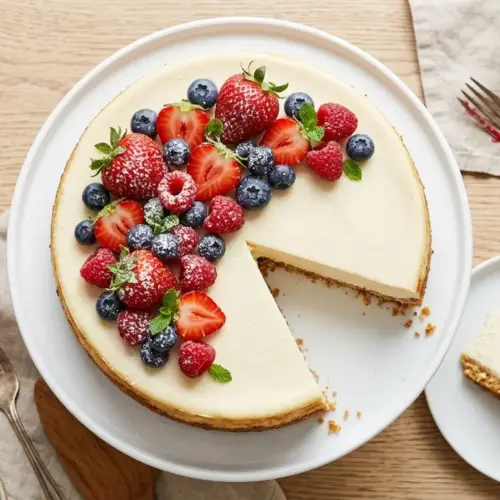
Gluten Free Cheesecake

This gluten free cheesecake delivers a silky, rich, and deeply creamy filling with a buttery crust that snaps just the way you want it to. You would never guess this cheesecake skips gluten entirely, making it genuinely indistinguishable from a traditional version.
Equipment
- 9-inch springform pan - must-have for cheesecake
- Food processor or blender - for crushing the graham crackers evenly
- Stand mixer or hand mixer - for beating the cream cheese filling
- Large roasting pan - to hold water for the water bath
- Heavy-duty aluminum foil - to wrap the springform pan
- Rubber spatula
- Measuring cups and spoons
- Large mixing bowls
- Offset spatula or back of a spoon - for smoothing the top of the filling
- Oven thermometer - optional but helpful for precision
Ingredients
- 2 cups gluten-free graham cracker crumbs - 200g, from about 14 full sheets
- 3 tablespoons granulated sugar - 37g, for the crust
- 6 tablespoons unsalted butter - 85g, melted
For the Filling
- 32 oz full-fat block cream cheese - 900g, softened to room temperature, not tub spreadable kind
- 1 cup granulated sugar - 200g, for the filling
- 1 cup full-fat sour cream - 240g, room temperature
- 3 large eggs - room temperature
- 2 teaspoons pure vanilla extract - not imitation
- 2 tablespoons cornstarch - 16g
- 1 tablespoon freshly squeezed lemon juice
- salt - pinch
Optional Toppings
- fresh strawberries - or blueberry compote, lemon curd, or caramel sauce
- whipped cream - for serving, optional
Instructions
- Preheat your oven to 325°F (163°C). Wrap the outside of a 9-inch springform pan with two layers of heavy-duty aluminum foil and spray the inside with non-stick cooking spray.
- Pulse gluten-free graham crackers in a food processor to fine crumbs, then mix with 3 tablespoons sugar and 6 tablespoons melted butter until combined and resembling damp sand. Press firmly into the bottom and 1 inch up the sides of the prepared pan. Bake for 8-10 minutes until lightly toasted, then cool.
- Beat room-temperature cream cheese on medium-low speed for 2-3 minutes until completely smooth with no lumps, scraping down sides frequently.
- Add 1 cup sugar, cornstarch, and salt, beating on low until combined. Add vanilla extract and lemon juice, beating until incorporated. Scrape down bowl thoroughly.
- Add sour cream and beat on low until smooth. Add eggs one at a time, beating on the lowest speed just until the yolk disappears. Do not overmix. Scrape and briefly mix by hand with a spatula.
- Pour filling over the cooled crust and smooth the top. Place the springform pan inside a large roasting pan and carefully pour hot water into the roasting pan until it reaches about 1 inch up the sides of the springform pan.
- Bake at 325°F (163°C) for 55-65 minutes. The cheesecake is done when the outer 2-3 inches are set but the center still jiggles slightly like Jell-O. Do not open the oven door during the first 45 minutes.
- Turn off the oven and leave the cheesecake inside with the door closed for 1 hour. Then open the door slightly and cool for another 30 minutes. Remove from the water bath and run a thin knife around the edges. Cool at room temperature for 1-2 hours, then refrigerate for at least 4 hours, preferably overnight.
- Remove foil from the pan, run a knife around the edge again, and release the springform ring. Transfer to a serving plate, slice with a sharp knife wiping the blade between cuts, and add toppings just before serving.
Notes
- Always start with room-temperature ingredients. Cold cream cheese, sour cream, and eggs are the most common cause of a lumpy, uneven batter. Set them out at least 1-2 hours before mixing.
- Do not overmix after adding eggs. Once the eggs go in, mix on the lowest possible speed and stop as soon as the batter is smooth. Excess air in the batter leads to cracks and a spongy rather than dense texture.
- Use two layers of heavy-duty foil on the springform pan. A single layer of regular foil often lets water seep through into the crust during the water bath. Heavy-duty, doubled foil gives much more reliable protection.
- Do not skip the water bath. It is the most reliable way to achieve a creamy, crack-free top and a uniformly set filling.
- Use block cream cheese, not the tub spreadable kind. Tub cream cheese has added stabilizers and higher water content that will make your filling too soft and runny.
- Cool the cheesecake slowly. The long oven cool-down is not optional. Rapid temperature changes cause the filling to contract unevenly and crack.
- Chill overnight for best results. A cheesecake pulled from the refrigerator after just 4 hours is edible, but one chilled overnight has a firmer texture and a much more developed, deep flavor.
- Store covered in the refrigerator for up to 5 days. The flavor actually improves after the first 24 hours as the ingredients meld together.
- Freeze the fully cooled, un-topped cheesecake (or individual slices) wrapped tightly in plastic wrap and aluminum foil for up to 2 months. Thaw overnight in the refrigerator before serving.
- Do not add toppings before storing. Fresh fruit and sauces release moisture that can make the top of the cheesecake soggy. Always add toppings just before serving.