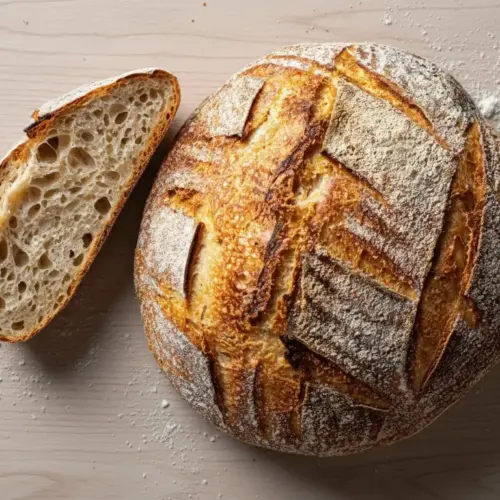
Easy Sourdough Bread

This simplified sourdough recipe delivers that signature tangy flavor, crispy golden crust, and soft, airy interior with just four basic ingredients and minimal hands-on work.
Equipment
- Large mixing bowl - Glass or ceramic works best
- Digital kitchen scale - For accurate measurements
- Dough scraper or bench knife
- Banneton proofing basket - Or a bowl lined with a clean kitchen towel
- Dutch oven - 5-6 quart capacity with a lid
- Parchment paper - For easy transfer
- Bread lame or sharp razor blade - For scoring
- Kitchen thermometer - For checking dough temperature
- Clean kitchen towels or plastic wrap - For covering dough
- Spray bottle (optional) - For adding steam
- Wire cooling rack (optional)
Ingredients
- 100 g active sourdough starter - 1/2 cup, bubbly and at peak fermentation
- 350 g lukewarm water - 1 1/2 cups, filtered or bottled, 75-80°F (24-27°C)
- 500 g bread flour - 4 cups, preferably unbleached
- 10 g sea salt - 2 teaspoons, fine or kosher
For Dusting (Optional)
- rice flour - Or all-purpose flour, for dusting banneton
Instructions
- Whisk the active sourdough starter into lukewarm water until dissolved. Add bread flour and mix until you have a shaggy, sticky mass.
- Cover the bowl and let the dough rest at room temperature for 30 minutes to 1 hour.
- Sprinkle the salt over the dough. Wet your hands, then perform 4-6 stretch and folds by grabbing one edge, stretching it up, and folding it toward the center.
- Cover the bowl and rest for 30 minutes. Perform another set of stretch and folds. Repeat for a third set. Then bulk ferment for 6-8 hours until doubled in size with bubbles on the surface.
- Turn the dough onto a lightly floured surface. Pull the edges toward the center to create tension, then flip and form into a round ball. Rest uncovered for 20-30 minutes.
- Dust your banneton with flour. Flip the dough, fold the bottom third up and top third down, then roll tightly from top to bottom. Pinch the seam closed and place seam-side up in the banneton.
- Cover the banneton and refrigerate for at least 12 hours, preferably 24-48 hours for better flavor.
- Place your Dutch oven with lid on in a cold oven. Preheat to 500°F (260°C) for a full hour.
- Turn the dough out onto a parchment paper. Dust with flour if desired. Make one deep score across the top with a bread lame at a 45-degree angle. Transfer dough to the hot Dutch oven using the parchment. Cover and bake at 500°F for 20 minutes. Remove lid, reduce heat to 450°F (230°C), and bake for 25-30 minutes more until deep golden brown.
- Lift the bread onto a wire cooling rack using the parchment. Cool completely for at least 1-2 hours before slicing.
Notes
- Starter readiness: Always use the float test before making dough. Drop a small spoonful of starter into water; if it floats, it's ready. If it sinks, feed it again and wait.
- Temperature control: Keep your dough between 75-78°F during bulk fermentation. Warmer kitchens ferment faster, cooler ones slower.
- All-purpose flour substitute: Reduce water to 325g (1 3/8 cups) when using all-purpose flour. The bread will have a softer texture.
- No Dutch oven alternative: Bake on a baking stone or sheet pan. Place a metal pan on the bottom rack and add boiling water when you put the bread in to create steam.
- Adjusting sourness: For more tang, extend cold proof to 48 hours. For less sourness, reduce bulk fermentation time or use starter when freshly fed.
- Storage: Store cut-side down at room temperature in a paper bag or bread box for 2-3 days. Never store in plastic which softens the crust.
- Freezing: Slice the entire loaf, wrap tightly in plastic wrap then foil, and freeze for up to 3 months. Toast slices directly from frozen.
- Reheating: Spritz a whole loaf with water and bake at 350°F for 10 minutes to restore crispiness.
- Make-ahead timeline: Mix dough in the morning (8:00 AM), perform stretch and folds until 11:00 AM, bulk ferment until 4:30 PM, shape and refrigerate overnight, bake the next morning.