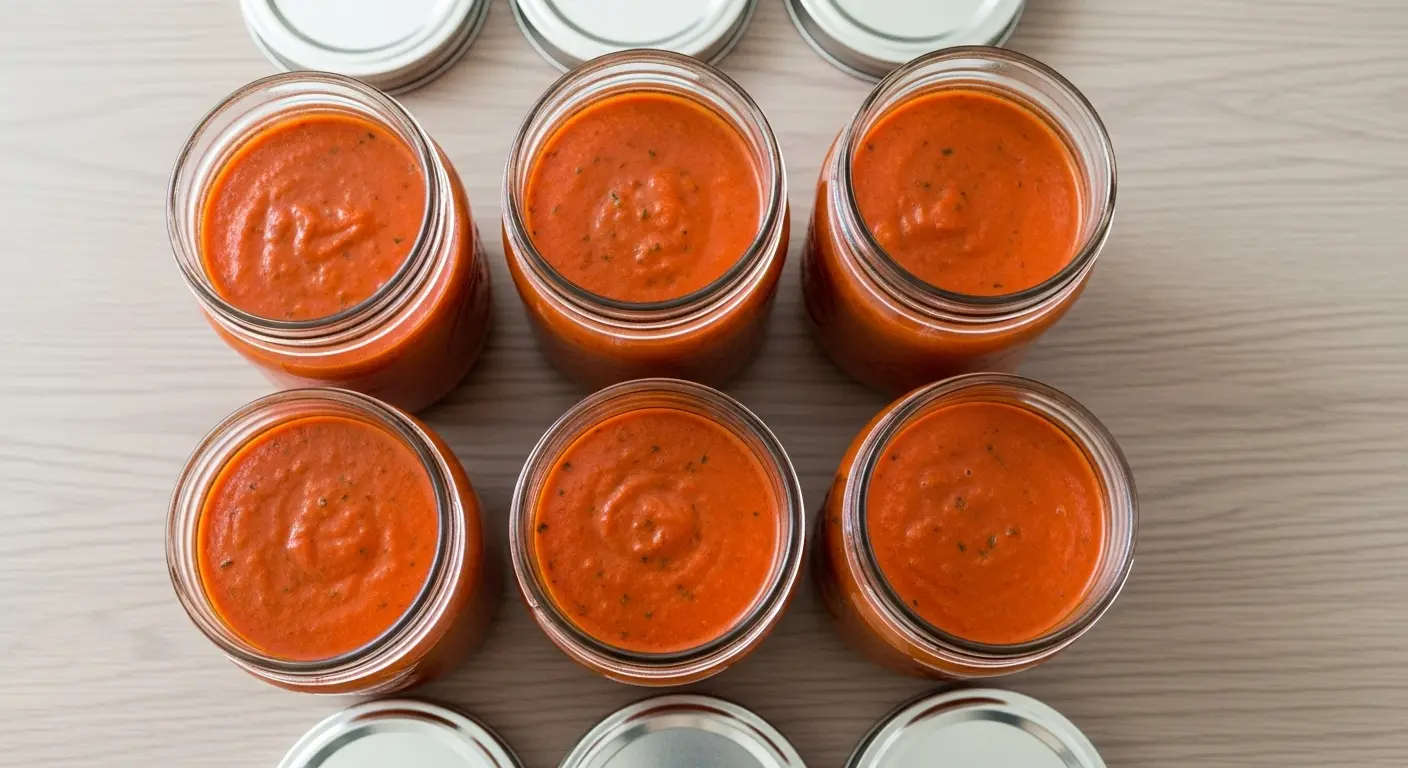
Canning Tomato Soup

Fresh garden tomatoes at their peak deserve to be enjoyed all year long. This canning tomato soup recipe transforms your summer harvest into shelf-stable jars of comfort that will warm your kitchen throughout the cold months. Unlike store-bought versions packed with preservatives and sodium, this homemade version lets you control every ingredient while creating a versatile concentrated base you can customize when you're ready to serve.
Equipment
- Pressure canner or water bath canner
- Large stockpot - 8-quart minimum
- Blender or immersion blender
- Food mill or fine-mesh strainer - (optional)
- Quart-sized canning jars - 6–8 jars
- New canning lids and bands
- Jar lifter
- Canning funnel
- Bubble remover tool or plastic chopstick
- Large bowl
- Ladle
- Clean kitchen towels
Ingredients
- 12 lbs fresh tomatoes - 5.4 kg, any variety; slightly overripe is fine
- 2 medium yellow onions - quartered
- 4 stalks celery - roughly chopped
- 6 cloves garlic - peeled
- 1/4 cup fresh basil leaves - about 10g
- 2 tbsp sugar - 30ml; increase to 3 tbsp for sweeter Campbell's-style soup
- 1 tbsp salt - 18g; can be reduced to taste
- 1 tsp black pepper - 2g
- 2 tbsp bottled lemon juice - per quart jar; OR substitute 1/2 tsp citric acid per quart jar — do not omit
For Serving (add when ready to eat)
- 1-2 cups milk, cream, or broth - per quart of soup base; to thin to desired consistency
- additional seasonings - to taste
- butter or olive oil - optional, for richness
Instructions
- Wash canning jars in hot soapy water and keep warm in a low oven (170°F/77°C) or dishwasher. Fill your canner with water per manufacturer instructions and set new lids in hot (not boiling) water to soften the sealing compound.
- Score an X in the bottom of each tomato, blanch in boiling water for 45–60 seconds until skins split, then transfer immediately to an ice bath. Once cool, peel, halve, core, and roughly chop the tomatoes — squeezing out excess seeds for a thicker soup.
- Blend onions, celery, garlic, and basil until finely minced, then transfer to your large stockpot. Blend chopped tomatoes in batches until smooth (or slightly chunky), adding each batch to the pot.
- Stir in sugar, salt, and pepper, then bring to a gentle simmer over medium heat. Cook on low for 20–30 minutes, stirring occasionally, until the mixture reduces by about one-quarter. Use an immersion blender or food mill for a silkier texture if desired.
- Remove warm jars one at a time and add 2 tbsp bottled lemon juice (or 1/2 tsp citric acid) to each quart jar using a canning funnel. This step is essential for safe canning and must not be skipped.
- Ladle hot soup into each jar leaving 1 inch of headspace, then run a bubble remover tool around the inside edge to release air. Wipe the rims clean, center a lid on each jar, and screw on a band until fingertip-tight.
- Secure the canner lid, heat on high until steam vents for 10 minutes, then add the weight and bring to 10 lbs pressure (weighted gauge) or 11 lbs (dial gauge). Process quart jars for 25 minutes, then turn off heat and allow pressure to return to zero naturally before opening.
- Ensure jars are covered by at least 1 inch of water, bring to a rolling boil, and process quart jars for 40 minutes (start timing once water returns to a full boil). Adjust processing time for altitude above 1,000 ft per USDA guidelines.
- Lift jars onto a towel-covered counter and leave undisturbed for 12–24 hours. Check seals by pressing the center of each lid — it should not flex. Label with contents and date, then store in a cool, dark place for up to 18 months.
Notes
- Use bottled lemon juice: Fresh lemon juice has variable acidity and is not approved for safe home canning — always use bottled.
- Don't skip the acid: Lemon juice or citric acid is required for safe processing in a water bath canner and must be added to every jar.
- Choose ripe tomatoes: Use tomatoes at peak ripeness; slightly overripe is fine, but avoid green or underripe tomatoes for best flavor.
- Mix tomato varieties: Combining paste tomatoes (like Roma) with juicier varieties produces better texture and more balanced flavor.
- No dairy before canning: Never add cream, milk, or butter prior to canning — they cannot be safely preserved. Add them only when reheating to serve.
- Altitude adjustments: If you live above 1,000 feet, adjust processing time or pressure according to USDA guidelines.
- Seal check: A properly sealed lid will not flex when pressed and may have a slight concave indentation. Refrigerate any unsealed jars and use within one week.
- Storage: Store sealed jars in a cool, dark location (50–70°F/10–21°C) for up to 18 months. Discard any jar with a bulging lid, broken seal, or off smell.
- Serving tip: Add 1–2 cups of milk, cream, or broth per quart of soup base when reheating. Swirl in butter or pesto for extra richness.
- Flavor variations: Try roasting tomatoes at 375°F for 45 minutes before processing for a deeper, sweeter flavor, or add dried oregano and thyme for an Italian-style base.