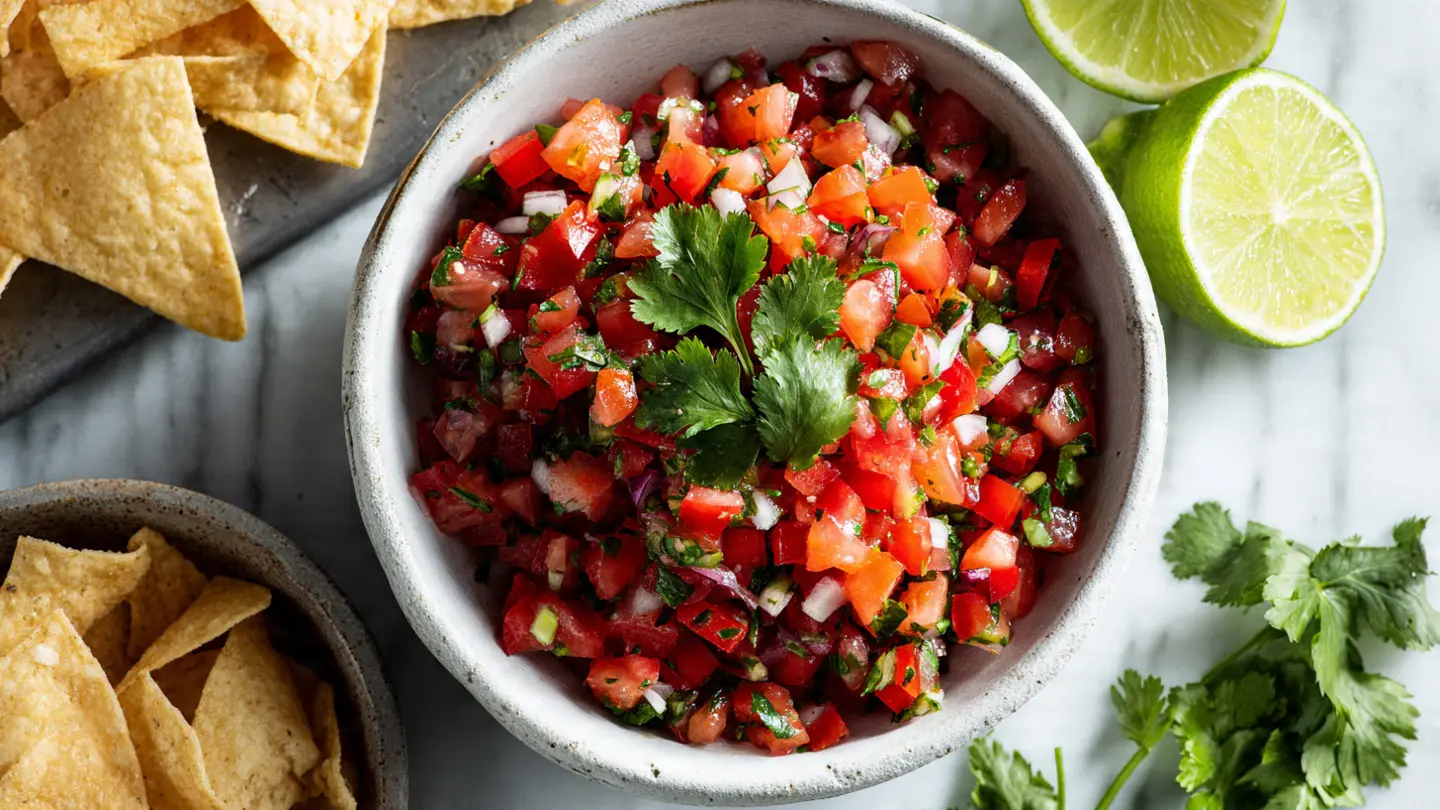
If you’ve ever tasted a truly great pico de gallo recipe, you know that nothing from a jar even comes close. This classic Mexican fresh salsa is made with just a handful of simple ingredients, yet the flavor is so bright, so vibrant, and so satisfying that it has a way of disappearing off the table in minutes.
Pico de gallo, also known as salsa fresca, is one of those recipes that proves fresh ingredients do all the heavy lifting.
Every bite delivers a perfect balance of sweet tomato, sharp white onion, fragrant cilantro, fiery jalapeño, and a squeeze of lime that ties everything together.
The best part? You don’t need a stove, a blender, or any special equipment. Just a sharp knife, a cutting board, and about 15 minutes.
This is the version you’ll find in authentic Mexican homes and taquerias, made the traditional way: chopped by hand, mixed together raw, and served fresh. No cooking, no blending, no shortcuts.
Once you make it this way, you’ll never go back to store-bought.
Fresh Salsa pairs beautifully with this recipe if you’re looking for another bright, tomato-based dip to serve alongside it.
Why You’ll Love This Pico de Gallo Recipe
This recipe is as close to foolproof as it gets.
You’re working with ingredients that are widely available, budget-friendly, and naturally delicious on their own. Together, they’re incredible.
There’s no cooking time, which means this comes together faster than just about any other condiment or side you could make.
It’s also incredibly versatile. This pico de gallo works as a dip, a topping, a filling, a salad component, and more.
The flavor is clean and fresh in a way that cooked salsas simply can’t replicate.
Here’s why readers keep coming back to this recipe:
- Ready in 15 minutes with zero cooking required
- Only 6 core ingredients that you can find in any grocery store
- Completely customizable in terms of heat level and texture
- Naturally vegan, gluten-free, and low-calorie with no compromise on flavor
- Tastes dramatically better than anything from a jar or store shelf
- Improves as it sits, meaning leftovers are even more flavorful the next day
Another reader favorite to try alongside this is classic guacamole for a complete Mexican-inspired appetizer spread.
Ingredients
The secret to great pico de gallo is using the freshest, ripest produce you can find. Roma tomatoes are the traditional choice because they’re meaty, low in moisture, and have a rich flavor that holds up well when chopped. Avoid watery beefsteak tomatoes here, as they’ll make the pico de gallo too soupy.
Here’s everything you need:
- 6 medium Roma tomatoes (about 1.5 lbs / 680g), seeds removed, finely diced
- 1/2 medium white onion (about 1 cup / 160g), finely diced
- 1/2 cup (25g) fresh cilantro leaves, roughly chopped
- 1 to 2 jalapeño peppers, seeds and membranes removed for mild heat (or kept in for extra heat), finely minced
- 2 tablespoons (30ml) fresh lime juice (from about 1 to 2 limes)
- 1/2 teaspoon (3g) kosher salt, plus more to taste
- Optional: 1 small clove of garlic, finely minced (adds depth, though not traditional in all versions)
Read Also: Easy Salsa Recipe
Kitchen Equipment Needed
You really only need a few basic tools for this recipe, making it one of the easiest things to prep in your kitchen. The most important piece of equipment is a sharp chef’s knife. A dull knife will bruise and crush the tomatoes rather than slicing cleanly through them, which affects both texture and moisture release.
Here’s what to have on hand:
- Sharp chef’s knife for clean, precise chopping
- Large cutting board with a stable base
- Mixing bowl (medium to large, for tossing and combining)
- Citrus juicer or reamer for extracting lime juice without seeds
- Measuring spoons for accurate seasoning
- Fine mesh strainer or colander (optional, for draining excess tomato liquid)
Read Also: Taco Seasoning Recipe
Recommended Products for This Recipe
These are products I recommend based on quality and performance. Each one makes the process smoother and the results noticeably better.
1. Victorinox Fibrox Pro Chef’s Knife
A sharp, well-balanced knife is the single most important tool for making pico de gallo. This Victorinox model is a professional-grade knife at an accessible price, and it makes clean, precise cuts through tomatoes without crushing them. Clean cuts mean less juice released, which keeps your pico de gallo from becoming watery.
2. OXO Good Grips Citrus Juicer
Fresh lime juice is non-negotiable in this recipe, and a dedicated citrus juicer makes quick, mess-free work of it while catching seeds automatically. The OXO design is comfortable to use and extracts maximum juice from each lime. You’ll use this constantly once you have it.
3. Molcajete Mortar and Pestle
A traditional volcanic stone molcajete not only looks stunning on the table, it actually serves a functional purpose: the rough texture slightly bruises the ingredients, releasing more flavor and blending everything together more harmoniously than a glass bowl. Serving pico de gallo directly from a molcajete is a classic presentation in Mexican cuisine.
4. Lime Squeezer Handheld Press
A handheld lime squeezer gives you quick, one-handed juice extraction with no seeds and maximum output. It’s one of those simple tools that makes a surprising difference in daily cooking, especially for recipes like this one that rely heavily on fresh citrus.
You might also enjoy: Easy Guacamole Recipe
Step-by-Step Instructions
Step 1: Prepare the Tomatoes
- Start with 6 medium Roma tomatoes (about 1.5 lbs / 680g). Give them a rinse under cold water and pat dry.
- Cut each tomato in half lengthwise. Use a small spoon or your fingers to scoop out and discard the seeds and the gel surrounding them. This is the most important step for avoiding watery pico de gallo.
- Place each deseeded tomato half cut-side down on your cutting board. Slice it lengthwise into strips about 1/4 inch (6mm) wide, then rotate and cut crosswise to produce a fine, uniform dice.
- Aim for pieces that are roughly 1/4 inch (6mm) across. Consistent sizing means every bite has a balanced mix of all the ingredients.
- Transfer the diced tomato to a bowl or colander. If you notice a lot of liquid pooling at the bottom, tilt the bowl and drain it off before proceeding.
Step 2: Dice the Onion
- Take 1/2 medium white onion and cut off the top (non-root) end. Leave the root end intact; it holds the layers together while you cut and makes for much safer, more controlled chopping.
- Peel off the papery outer skin.
- Slice the onion half into thin vertical planks, cutting almost but not quite through the root end so it holds together.
- Rotate the onion 90 degrees and cut crosswise to produce a fine dice. You should end up with about 1 cup (160g) of diced white onion.
- White onion is traditional for pico de gallo. It has a sharp, clean flavor that balances the sweetness of the tomato. Yellow onion is milder; red onion has a slightly bitter edge, though either can work in a pinch.
- Add the diced onion to the bowl with the tomatoes.
Step 3: Mince the Jalapeño
- Take 1 to 2 jalapeño peppers depending on your heat preference. Rinse under cold water.
- Slice each jalapeño in half lengthwise. Use a small spoon to scrape out the seeds and the white membrane (the membrane contains most of the heat).
- For mild heat, remove all seeds and membrane. For medium heat, leave a small portion of the membrane. For a hotter pico de gallo, leave the seeds in entirely.
- Finely mince the prepared jalapeño into very small pieces, roughly 1/8 inch (3mm) or less. You want the heat to be distributed throughout the bowl rather than concentrated in larger chunks.
- After handling jalapeños, avoid touching your eyes and wash your hands thoroughly with soap and water.
- Add the minced jalapeño to the bowl.
Step 4: Chop the Cilantro
- Take 1/2 cup (25g) of fresh cilantro leaves. Strip the leaves from the thicker stems. Thin, delicate stems are fine to include; thick, fibrous stems should be discarded as they can taste bitter.
- Gather the leaves into a loose pile and run your knife through them with a rocking motion, chopping until they are roughly chopped but not turned into a fine paste. You want some texture here; over-processed cilantro turns mushy.
- Add the chopped cilantro to the bowl.
Step 5: Add Lime Juice and Salt
- Juice 1 to 2 fresh limes over the bowl, aiming for about 2 tablespoons (30ml) of juice. Fresh lime juice is essential here. Bottled lime juice lacks the floral, aromatic quality that makes a real difference in the final flavor.
- Add 1/2 teaspoon (3g) of kosher salt. If you’re using table salt, use a little less as it’s finer and saltier by volume.
- If using optional garlic, add 1 finely minced small clove at this point.
Step 6: Toss, Rest, and Taste
- Use a large spoon or silicone spatula to gently toss all the ingredients together until evenly combined.
- Taste the pico de gallo and adjust the seasoning. It may need a little more salt, another squeeze of lime, or more jalapeño depending on your preference.
- Let the bowl rest at room temperature for at least 10 to 15 minutes before serving. This resting time allows the salt to draw out a little moisture from the tomatoes, the flavors to meld together, and the sharpness of the raw onion to soften slightly.
- Taste once more before serving and make any final adjustments.
This classic recipe also complements birria tacos beautifully if you want to turn it into a full Mexican feast.
Tips for Success
Getting great results every time comes down to a few key habits that make a noticeable difference. The most common mistake people make is skipping the step of removing tomato seeds, which leads to a watery, diluted pico de gallo that doesn’t cling properly to chips or tacos.
Here are the tips that matter most:
- Always remove tomato seeds. This is the single biggest factor in controlling texture. Seeded tomatoes produce a pico de gallo that’s chunky and fresh rather than soupy.
- Dice everything uniformly. Consistent sizing means every chip scoop gets a balanced mix of all the ingredients. This is worth the extra minute of careful knife work.
- Use white onion, not yellow. White onion is sharper and more pungent, which provides the flavor contrast that defines classic pico de gallo.
- Let it rest before serving. Even 10 minutes of resting time dramatically improves the flavor as everything mingles and the salt draws out moisture.
- Taste and adjust. Every tomato and lime is different in terms of acidity and sweetness. Always taste before serving and add more salt or lime as needed.
- Use ripe, in-season tomatoes. This recipe is only as good as your tomatoes. If tomatoes are out of season and flavorless, consider cherry tomatoes, which tend to have more concentrated flavor year-round.
- Chill only if necessary. Pico de gallo served at room temperature actually has better flavor than cold. If making ahead, refrigerate but let it sit at room temperature for 10 minutes before serving.
For more Mexican-inspired flavor ideas, check out this Mexican street corn recipe to serve alongside.
Serving Suggestions
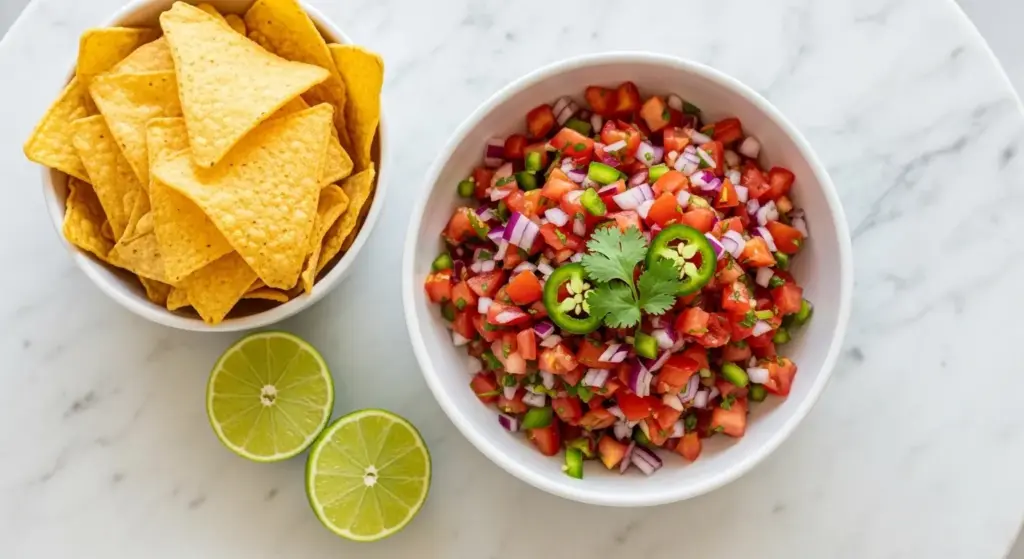
Pico de gallo is one of the most versatile condiments in the kitchen. It works as a fresh, bright counterpoint to rich, savory dishes, and it elevates even the simplest foods.
Here are some of the best ways to serve it:
- Alongside tortilla chips for a classic appetizer or snack
- Spooned over chicken fajitas for a fresh, acidic topping
- Heaped onto loaded nachos for extra color and brightness
- Mixed into easy guacamole for a chunky, textured variation
- Served alongside carne asada tacos in place of or alongside other salsa
- Used as a fresh topping for grilled fish, shrimp, or chicken
- Stirred into scrambled eggs or folded into a breakfast burrito
- Spooned over a taco skillet straight from the pan
Variations to Try
Once you’re comfortable with the classic version, it’s easy and fun to experiment with small tweaks that change the character of the dish entirely. The base technique stays the same; you’re simply swapping or adding ingredients to explore different flavor profiles.
Here are some popular and delicious variations:
- Mango pico de gallo: Replace 2 of the Roma tomatoes with 1 cup of finely diced fresh mango for a sweet, tropical version that pairs beautifully with grilled fish or shrimp tacos.
- Watermelon pico de gallo: Swap half the tomato for diced seedless watermelon and add a little extra lime juice. This variation is refreshing and unexpected at summer cookouts.
- Pineapple pico de gallo: Diced fresh pineapple adds a tangy sweetness that makes this version addictive on pork tacos or grilled chicken.
- Roasted pico de gallo: Briefly broil the tomatoes, onion, and jalapeño before chopping for a smokier, deeper flavor with a completely different character.
- Extra spicy version: Add a finely minced serrano pepper in addition to or instead of the jalapeño, and keep all seeds and membranes in.
- Cucumber pico de gallo: Add 1/2 cup of finely diced English cucumber for extra crunch and a cool, refreshing note.
This pico de gallo variation with mango would be outstanding served alongside enchiladas suizas for a full Mexican meal.
Storage and Reheating
Pico de gallo is best served fresh, but it stores very well in the refrigerator for a few days. In fact, many people find that the flavor actually improves after a few hours as the ingredients continue to marinate in the lime juice and salt.
Here’s everything you need to know about storing it properly:
- Refrigerator: Transfer leftover pico de gallo to an airtight container and store in the fridge for up to 3 days. After that, the tomatoes start to become mushy and the flavors lose their brightness.
- Draining liquid: As it sits, pico de gallo naturally releases liquid. Before serving leftovers, either drain off the excess liquid or give it a stir and serve as is, depending on your preference.
- Do not freeze: Pico de gallo does not freeze well. The tomatoes break down completely after thawing, turning the salsa into an unpleasant mush. Always make it fresh or within a day or two of serving.
- Room temperature serving: If your pico de gallo has been refrigerated, let it sit at room temperature for about 10 minutes before serving to take the chill off and allow the flavors to come forward.
- No reheating needed: This is a raw, fresh salsa. Do not reheat it; simply serve chilled or at room temperature.
Read Also: Flour Tortilla Recipe
Nutritional Facts
The following nutritional information is based on one serving, which is approximately 1/2 cup (about 120g) of pico de gallo. The recipe as written makes roughly 6 servings.
| Nutrient | Per Serving (1/2 cup) |
|---|---|
| Calories | 25 kcal |
| Total Fat | 0.2g |
| Saturated Fat | 0g |
| Carbohydrates | 5.5g |
| Dietary Fiber | 1.5g |
| Total Sugars | 3g |
| Protein | 1g |
| Sodium | 195mg |
| Vitamin C | 18mg (20% DV) |
| Potassium | 290mg (6% DV) |
Nutritional values are estimates based on standard ingredient data and may vary depending on exact quantities used.
For another naturally low-calorie snack to serve alongside, try this easy hummus recipe.
Health Benefits of Key Ingredients
Beyond being delicious, pico de gallo is genuinely good for you. Because it’s made entirely from raw, fresh vegetables, it retains the full nutritional profile of each ingredient without any degradation from heat.
Here are the standout health benefits of the key ingredients:
- Tomatoes are rich in lycopene, a powerful antioxidant associated with heart health and reduced risk of certain cancers. They’re also an excellent source of Vitamin C and Vitamin K, both of which play essential roles in immune function and bone health.
- White onion contains quercetin, a flavonoid with anti-inflammatory and antioxidant properties. Onions also provide prebiotic fiber, which supports a healthy gut microbiome.
- Jalapeño peppers are packed with capsaicin, the compound responsible for their heat, which has been studied for its metabolism-boosting and anti-inflammatory effects. They’re also high in Vitamins A and C.
- Fresh cilantro is loaded with antioxidants and has been studied for its potential to support detoxification and reduce inflammation. Some research suggests it may help lower blood sugar levels.
- Fresh lime juice provides a concentrated source of Vitamin C and citric acid, which supports iron absorption and digestive health.
This recipe is a fantastic addition to any clean-eating routine, complementing dishes like avocado toast for a nutritious, fresh-focused meal.
Frequently Asked Questions
1. What is the difference between pico de gallo and salsa?
Pico de gallo, also called salsa fresca, is a raw, fresh condiment made with chopped vegetables that are not blended or cooked. Traditional salsa can be blended, cooked, or roasted, which gives it a smoother texture and a more concentrated, developed flavor. Pico de gallo is chunkier and brighter in flavor, with each ingredient distinctly present in every bite.
2. Why does my pico de gallo get watery?
Watery pico de gallo is almost always caused by two things: not removing the seeds from the tomatoes and using tomatoes with a high water content, such as beefsteak tomatoes. Always deseed your tomatoes before dicing, and stick with Roma tomatoes for the best results. You can also lightly salt the diced tomatoes and let them sit in a colander for 10 minutes before mixing, then drain the liquid before combining with the other ingredients.
3. Can I make pico de gallo ahead of time?
You can make it up to a day ahead and it will taste even better after the flavors have had time to meld. If making it more than a few hours ahead, store it in an airtight container in the refrigerator and drain any excess liquid before serving. Avoid making it more than 24 hours in advance, as the tomatoes will start to break down and the cilantro will wilt.
4. How spicy is pico de gallo?
The heat level depends entirely on how you handle the jalapeño. Removing all seeds and the white membrane keeps it very mild. Leaving the seeds in makes it noticeably spicy. For an even milder version, use only half a jalapeño. For more heat, swap the jalapeño for a serrano pepper, which is about twice as spicy.
5. Can I use different tomatoes?
Roma tomatoes are the traditional choice and the best option for their meaty texture and low water content. If you can’t find ripe Romas, cherry tomatoes or grape tomatoes work very well because they’re consistently flavorful even out of peak season. Avoid large, watery tomatoes like beefsteak varieties as they make the pico de gallo too loose. If your tomatoes aren’t very ripe or flavorful, a tiny pinch of sugar can help bring out their natural sweetness.
Read Also: Corn Tortilla Recipe
Final Thoughts
Making pico de gallo from scratch is one of the most rewarding things you can do in the kitchen for the amount of time and effort it requires.
In about 15 minutes, you end up with something so fresh and vibrant that it genuinely transforms everything it touches.
The key is trusting the process: ripe tomatoes, sharp onion, fragrant cilantro, a hit of jalapeño heat, and enough lime juice and salt to make everything sing.
Give this pico de gallo recipe a try and see how quickly it becomes a staple in your home.
If you make it, I’d love to hear how it turned out. Leave a comment below and tell me what you served it with, or share a photo on social media and tag us.
Recommended:
- Fresh Salsa Recipe
- Classic Guacamole
- Chicken Tortilla Soup
- Mexican Street Corn
- Chicken Fajita Recipe
- Easy Nachos
- Classic Bruschetta
- Taco Seasoning Recipe
- Picadillo Recipe
- Mexican Beef and Rice Skillet